Historical and Geographical Context
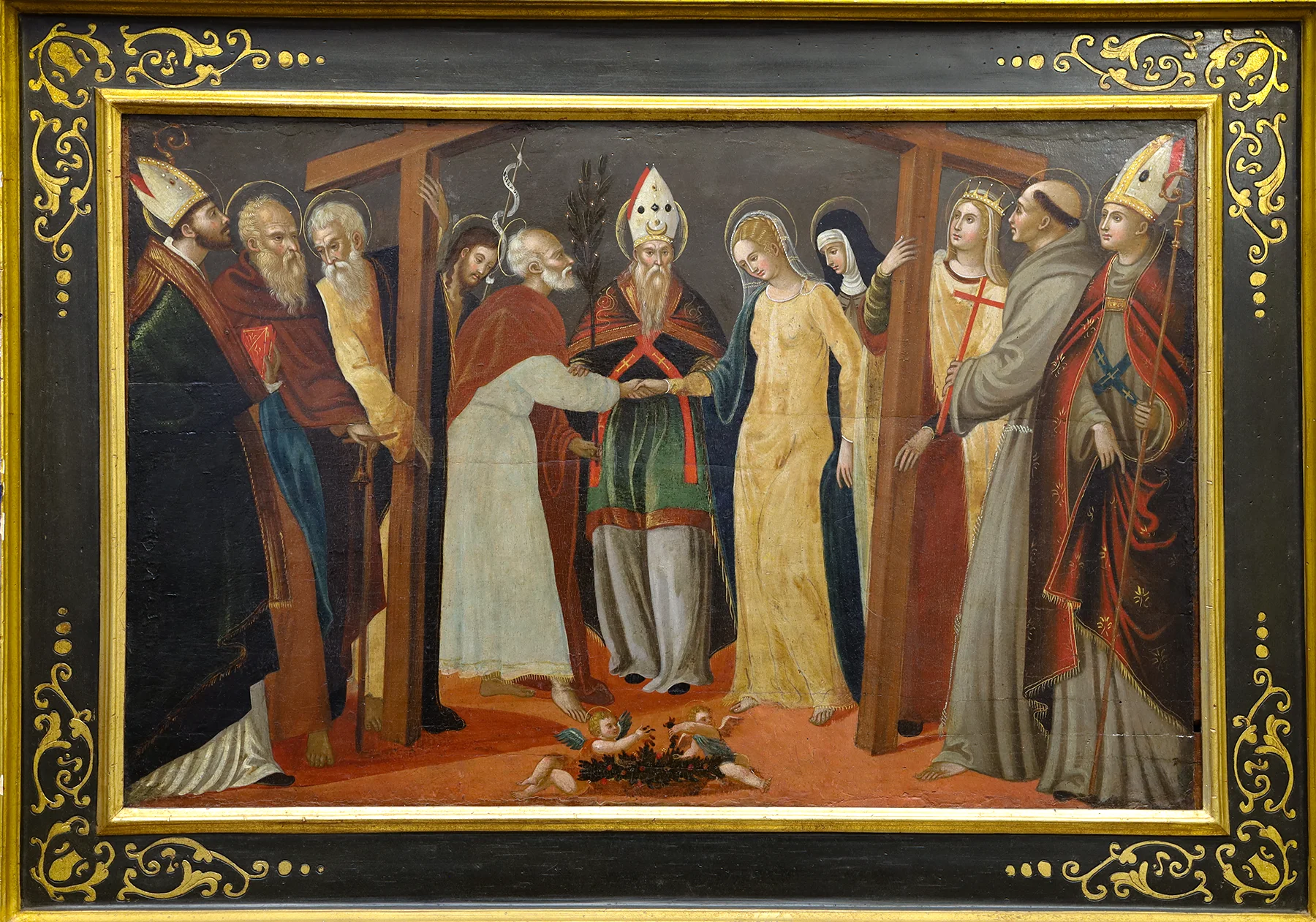
This refined panel painting depicting The Marriage of the Virgin can be attributed to the sphere of 16th-century Veneto-Cretan painting, a tradition characterized by a distinctive synthesis of Byzantine—more specifically, Palaeologan—style, introduced to Crete between the 14th and 15th centuries by artists from Constantinople and distinguished by elongated figures, elegant movements, and symmetrical compositions, together with models derived from Western, particularly Venetian, painting (Fig. 1).
This artistic language developed in Crete, especially in Candia (modern Heraklion), during the 16th and 17th centuries under Venetian rule (1204–1669), within a context of intense commercial and cultural exchange throughout the Mediterranean.
Cretan painters encountered Western art in several ways: through Italian works present in Candia—in Catholic churches, monasteries, and the private residences of the Venetian bourgeoisie and aristocracy—through the activity of Venetian painters’ workshops established there as early as the first half of the 14th century, and through the circulation of engravings. Consequently, artists working in Crete were already familiar with Western paintings and iconographic models by the second half of the 15th century and were capable of painting both “alla greca” (in the Greek manner) and “alla latina” (in the Latin manner), demonstrating remarkable versatility and adapting their artistic language to the requirements of different patrons.
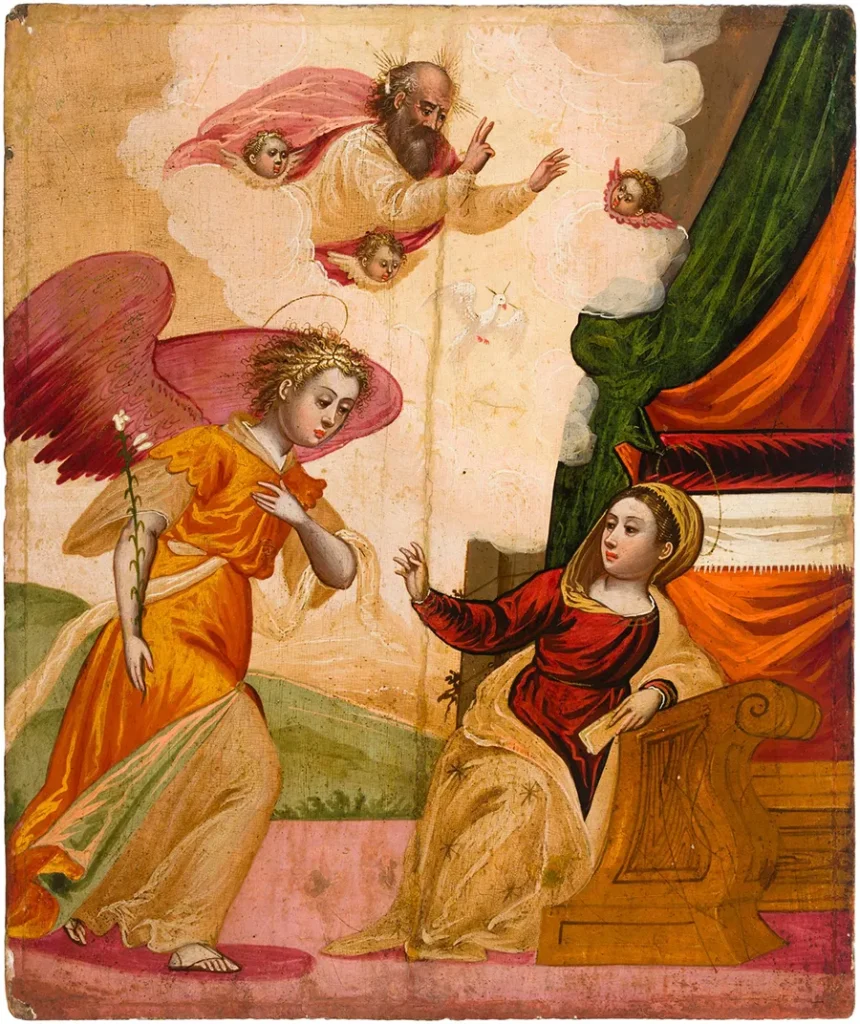
Icons painted “alla greca” had also been present in Venice since the 13th century. Written sources and documentary records attest to a growing presence of such works in churches and private residences throughout the city, particularly from the final decades of the 15th century onward. In Venice, the importation of Greek icons became an extremely profitable commercial activity, while the number of Cretan painters active in the city steadily increased over time.
Veneto-Cretan works can also be found in regions not directly tied to Venice but characterized by intense maritime trade, such as Calabria, Sicily, and Campania. The Adriatic area in particular witnessed a significant circulation of painted panels, both produced locally by qualified workshops and imported from Venice and Crete.
Artistic Patronage
From the standpoint of patronage, Veneto-Cretan paintings were commissioned by members of the upper and middle classes, influential individuals, clergy and lay patrons alike, belonging to both the Catholic and Orthodox (Greek) traditions. Panels depicting the Virgin, however, were also commissioned by humble patrons, often sailors and fishermen.
In Venice, the production of these works was fundamentally a commercial enterprise. Archival documents reveal that Greek and Venetian merchants regularly commissioned large quantities of paintings from Cretan icon painters and “madonneri,” which were subsequently sold in the Rialto market and in Piazza San Marco.
Analysis of the Painting
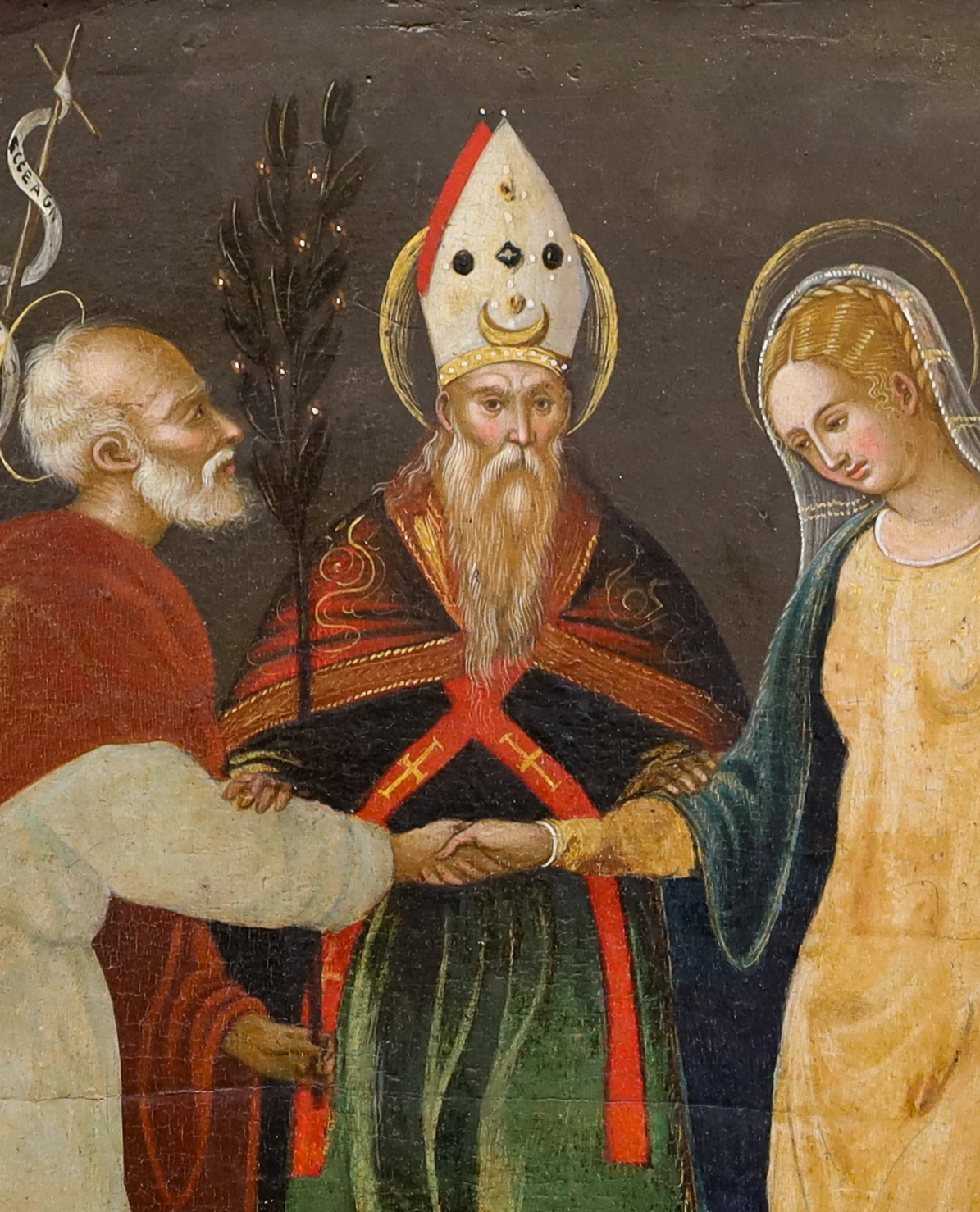
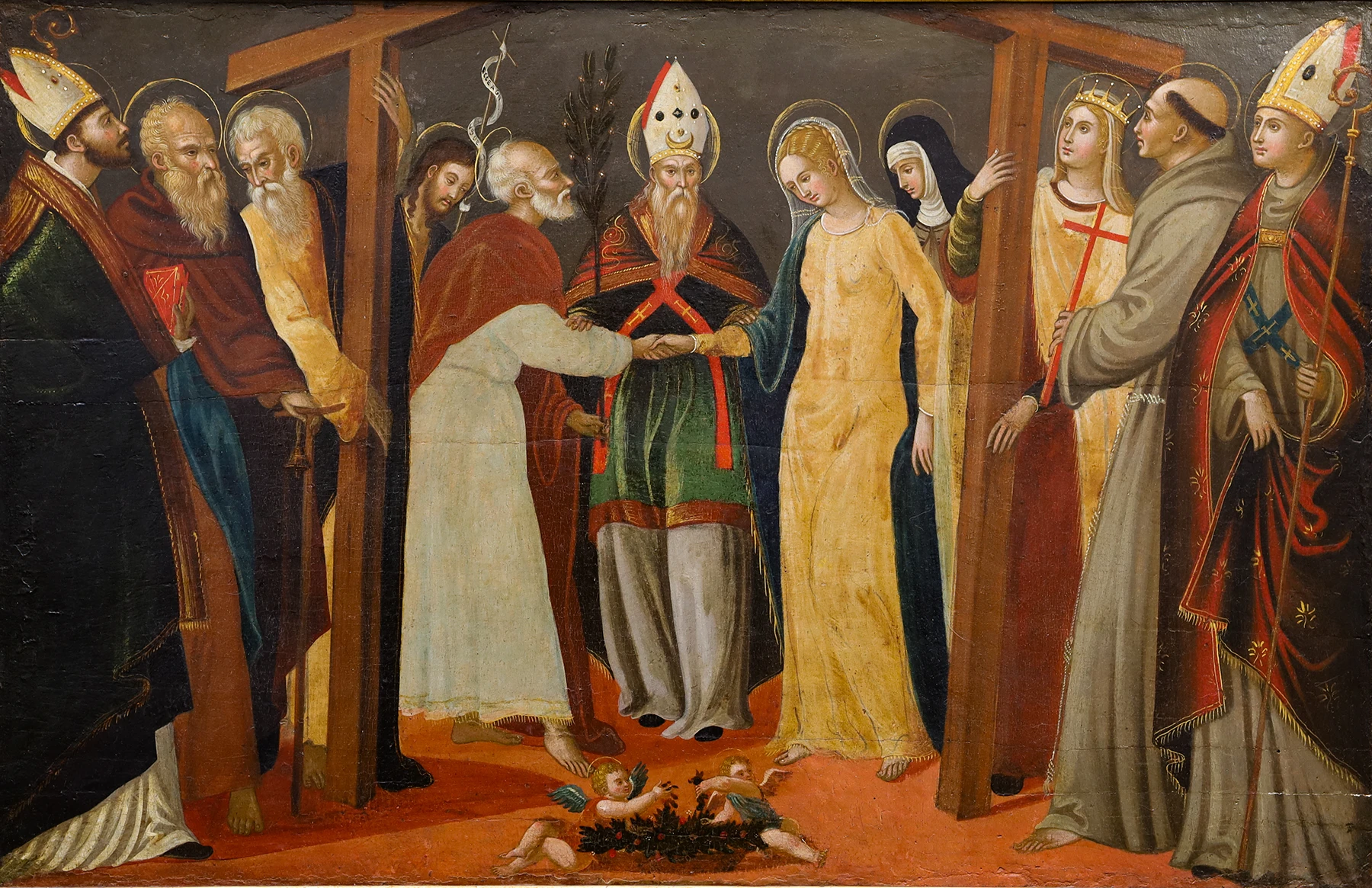
The present panel is distinguished by its exceptional quality of execution, suggesting the hand of a highly accomplished painter oriented toward Western artistic models and, most likely, a discerning patron, as indicated by both the subject matter and the dimensions of the work.
Indeed, The Marriage of the Virgin appears to be a relatively uncommon subject within Veneto-Cretan production, which was traditionally devoted to more established devotional themes such as the various types of the Virgin and Child, the Adoration of the Magi, the Crucifixion, or Christ Carrying the Cross.
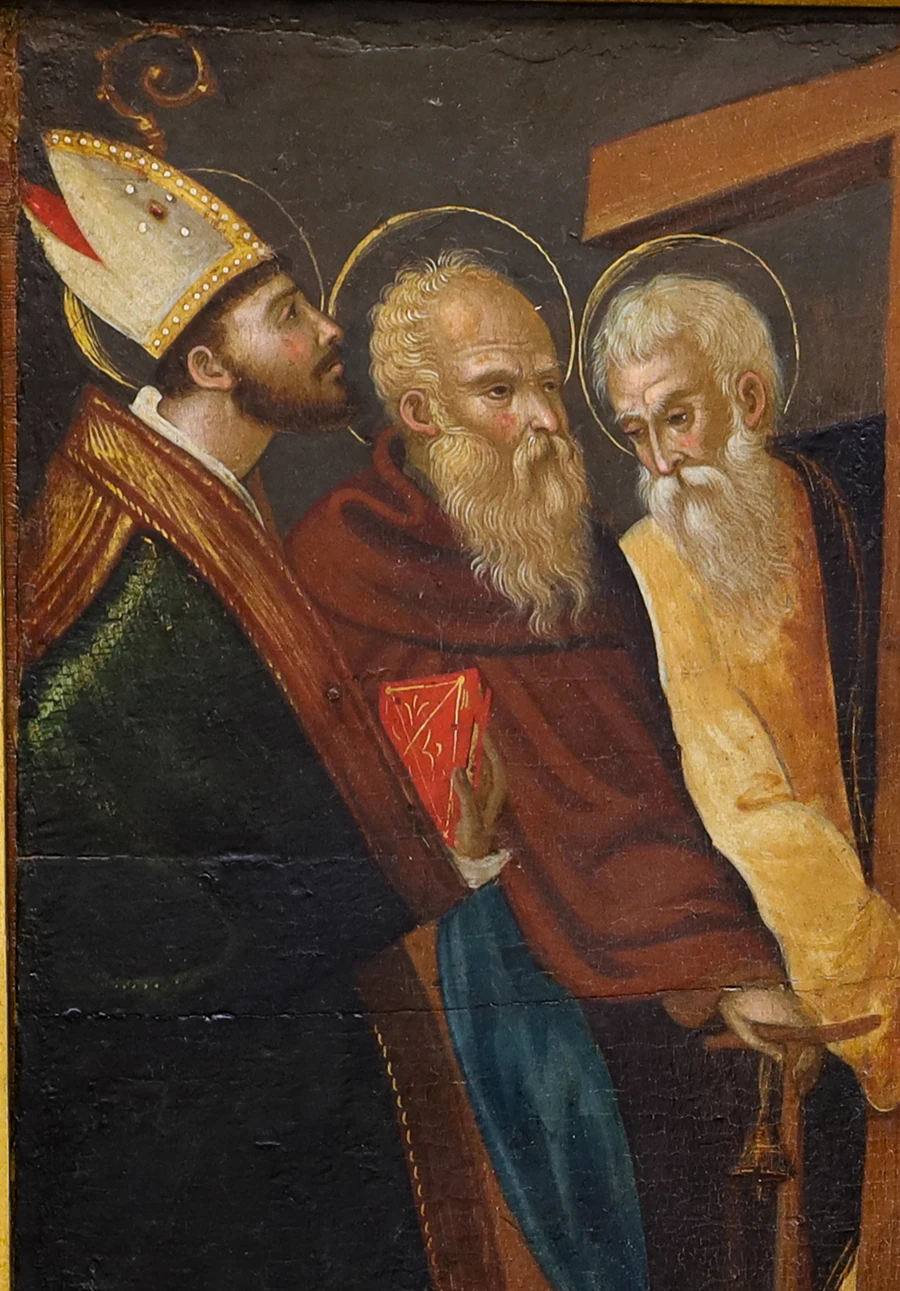
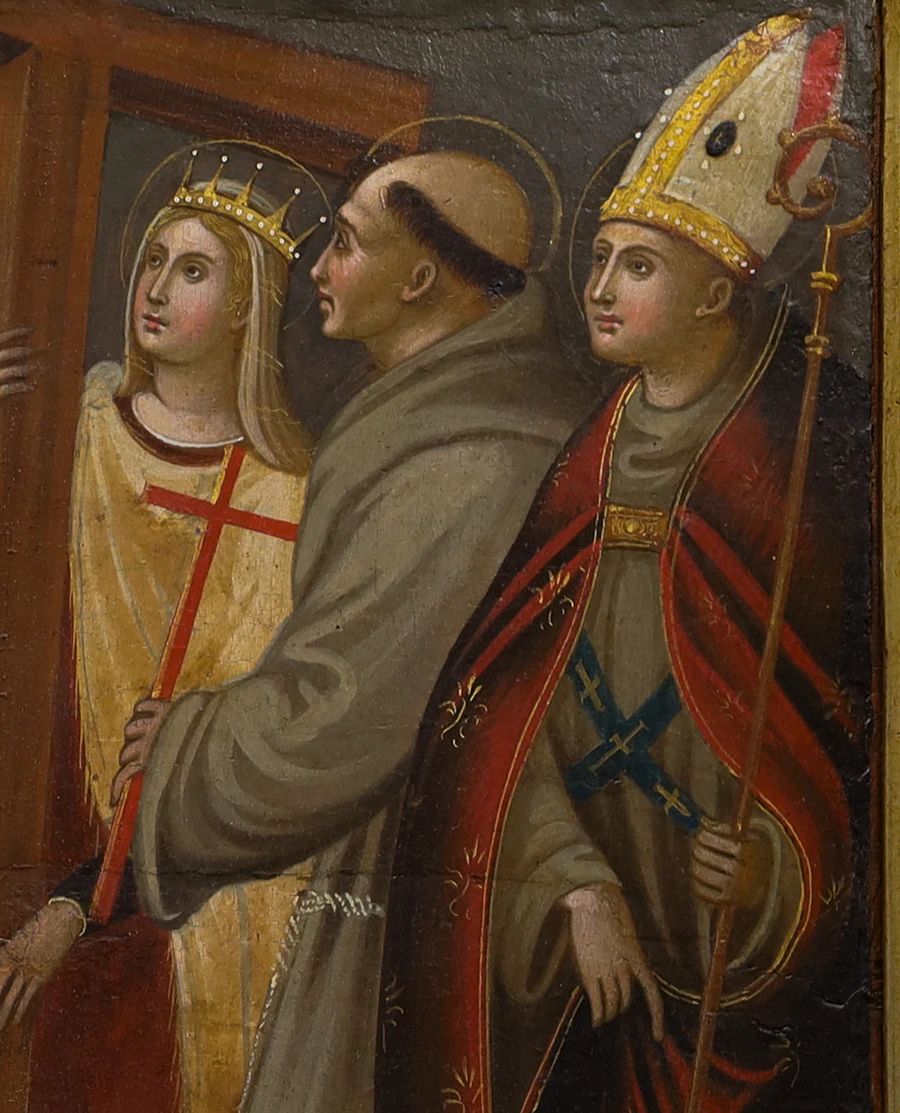
The composition follows the traditional Renaissance arrangement of the scene while introducing the highly original device of dividing the composition through the two crosses held by Saint Andrew and Saint Helena. Equally unusual is the placement of the saints flanking the Marriage scene, arranged in the manner of a sacra conversazione.
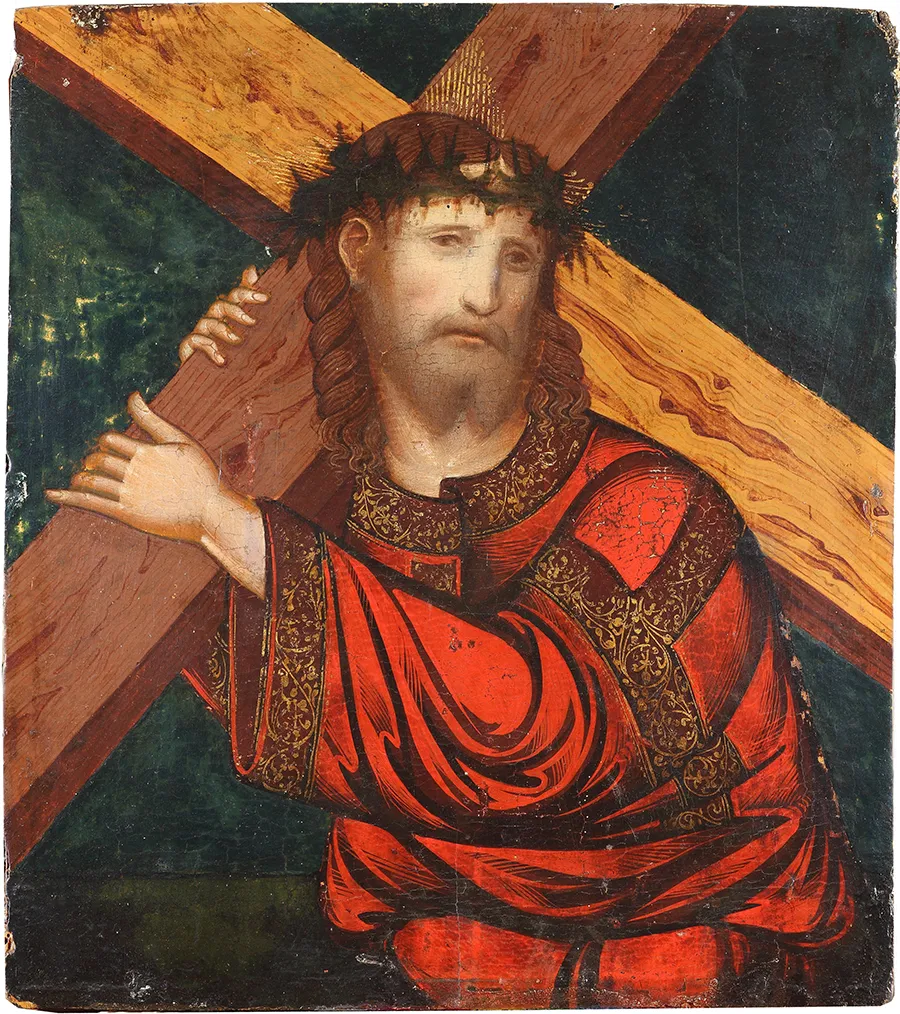
The dark background is likewise uncommon in Veneto-Cretan panel painting. In more Westernized examples, artists generally favored landscape settings, typically characterized by ochre tonalities. Among the few comparable works featuring a dark ground is Christ Carrying the Cross (16th century), preserved in the National Gallery of Apulia “Girolamo and Rosaria Devanna” in Bitonto.
Toward an Attribution
Assigning a specific name to the author of this panel is ultimately difficult, as is the case with the majority of Veneto-Cretan works. Many are identified today only through conventional designations such as the “Master of Cremona,” the “Master of Saint Jerome,” or the “Master of the L.”
Nevertheless, the present painter appears to have been particularly oriented toward Italian artistic models and was probably active either in Venice itself or along the Adriatic coast.
Among the numerous painters working in Italy, especially Venice—many of whom remain anonymous—it is worth mentioning Giovanni Permeniatis (active in Venice, c. 1523–1550), Michael Damaskinos (1530–1593), and the celebrated Domenikos Theotokopoulos, known as El Greco (1541–1614).
Among the artists currently known and considered in the course of this research, the only painter who displays several points of contact with the present work is the aforementioned Giovanni Permeniatis, a noteworthy interpreter of Italian art through Byzantine models. Only one signed and dated work by him is known, preserved in Venice at the Museo Correr, displaying elements derived from Bellini and Carpaccio. Recent scholarship has also attributed several additional works to the artist, including the Madonna and Child with Saints in the Pinacoteca Comunale of Ravenna.

Selected Bibliography
- S. Bettini, La pittura di icone cretese-veneziana e i madonneri, Padua, 1933.
- M. Bianco Fiorin, “Giovanni Permeniate pittore greco a Venezia e una tavola del Museo Nazionale di Ravenna,” Bollettino d’Arte, Series 6, Vol. 66, No. 11, 1981, pp. 85–88.
- M. Bianco Fiorin, “Pittori cretesi-veneziani e ‘madonneri’. Nuove indagini ed attribuzioni,” Bollettino d’Arte, Vol. 47, 1988, pp. 71–84.
- C. Gelao, “Tra Creta e Venezia – Le icone dal XV al XVIII secolo,” in Icone di Puglia e Basilicata. Dal Medioevo al Settecento, edited by P. Belli D’Elia, 1988, pp. 31–41.
- M. Costantoudaki-Kitromilides, “Icon Painting in Venetian Crete (15th–16th Centuries): Patronage, Iconography and Aesthetic Preferences,” in Venice and Crete (Proceedings of the International Conference, Heraklion–Chania, 30 September–5 October 1997), edited by G. Ortalli, Venice, 1998, pp. 459–507.
- D. Thomaidis, The Life of Icons in Venice between the 13th and 17th Centuries, PhD Dissertation, 2020.