Lazzaro Baldi’s artistic production
Baldi’s artistic production, predominantly devoted to religious subjects, is characterized by a synthesis of his master’s vibrant painterly manner and the more restrained language of Carlo Maratta (1625–1713), with references to Giovanni Lanfranco (1582–1647) and Neo-Venetian influences derived from Pier Francesco Mola (1612–1666). From this combination, Baldi developed a highly personal and recognizable style. He specialized primarily in the depiction of religious subjects, particularly martyrdoms and the lives of saints who were being canonized by the Church during his lifetime.
The repetition of similar commissions and their considerable number led the artist to adopt increasingly systematic working methods based on the reuse of established compositional schemes and figure types. Within this context, the organization of his workshop became essential. Composed of numerous young artists, Baldi’s studio was not intended primarily as a school for teaching a specific artistic style, but rather as a highly efficient workshop capable of producing faithful replicas of the master’s manner in order to satisfy the many commissions entrusted to him.
Studies by Pampalone (1979), Ferraris (1986), and Casale (1982, 1983, 2011) have clarified many aspects of the organization of Baldi’s workshop, whose intervention explains the stylistic inconsistencies frequently observable in his production, sometimes even within a single work. Among his pupils were Giovanni Battista Lenardi (1656–1704), Benedetto Luti, Biagio Cibocchi (active 1701), Francesco Simoncelli (active 1699), and Don Filippo Luzi (1665–1720). To meet the demands of his extensive commissions, Baldi also collaborated with painters of different backgrounds and origins, including Fabrizio Chiari (1615–1695), Angelo Massarotti (1654–1723), and Giovan Domenico Ponti (active 1678).
On certain occasions, such as the extensive cycle commissioned for the canonization in 1671 of Luis Beltrán (1526–1581), the Dominican missionary saint, more than forty collaborators participated in the execution of the works, among whom Spanish painters were almost certainly present.
Particularly significant within the organization of Baldi’s workshop was the production of drawings, which served as a repertory of models. For Baldi, drawing represented less the moment of invention than the combination and adaptation of previously developed elements, intended primarily for studying the arrangement of figures. These drawings are characterized by frequent reuse and a deliberate economy of detail, enabling them to be adapted to different subjects and iconographies. Consequently, they were not necessarily preparatory studies for a single painting but often related to several works, especially when recurring themes were involved.
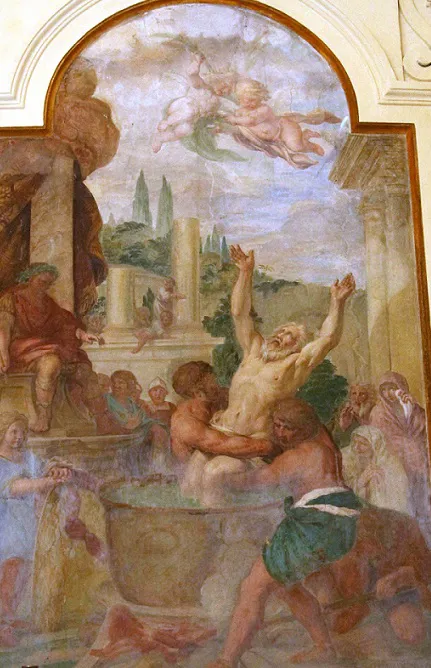
Analysis of the Painting
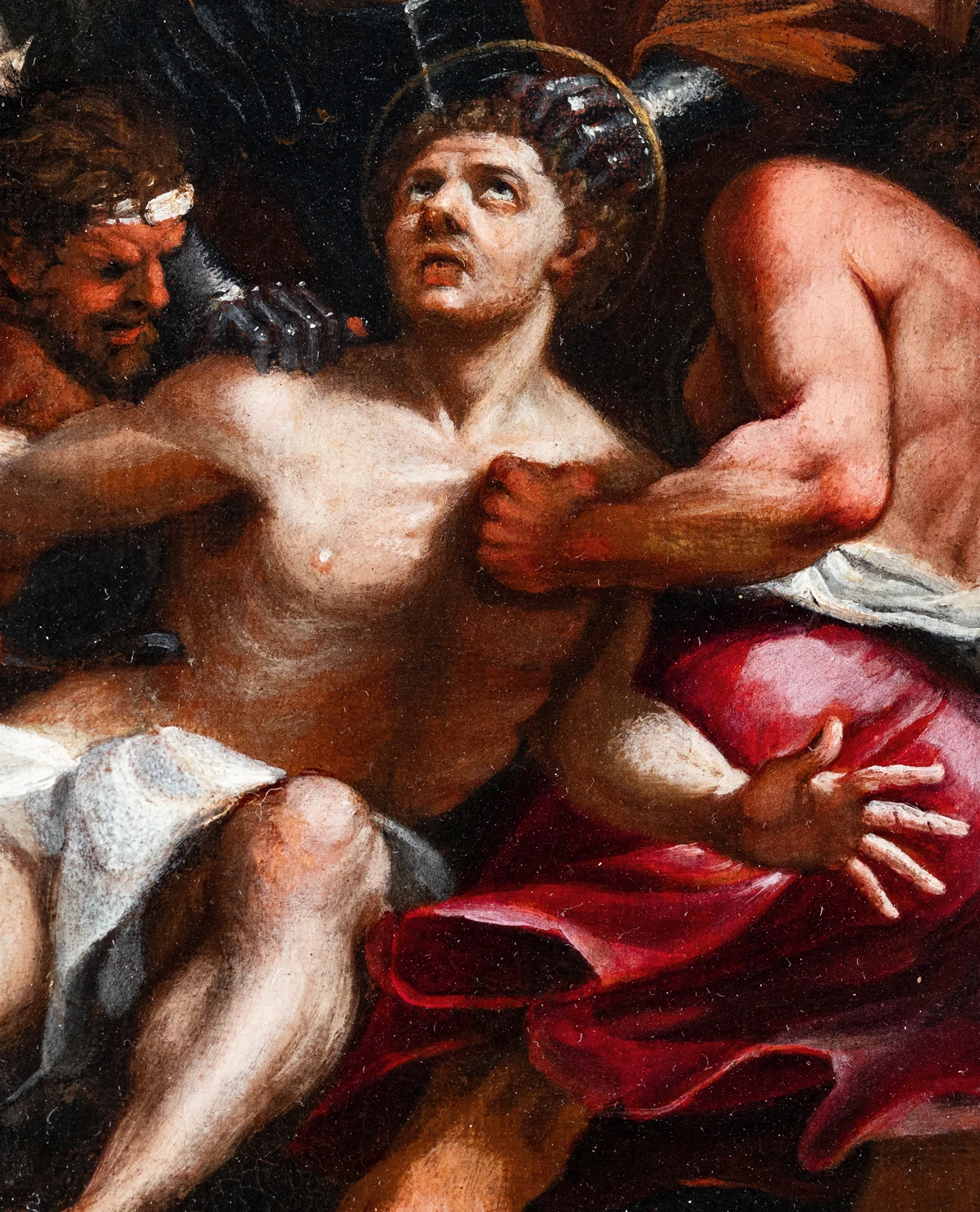
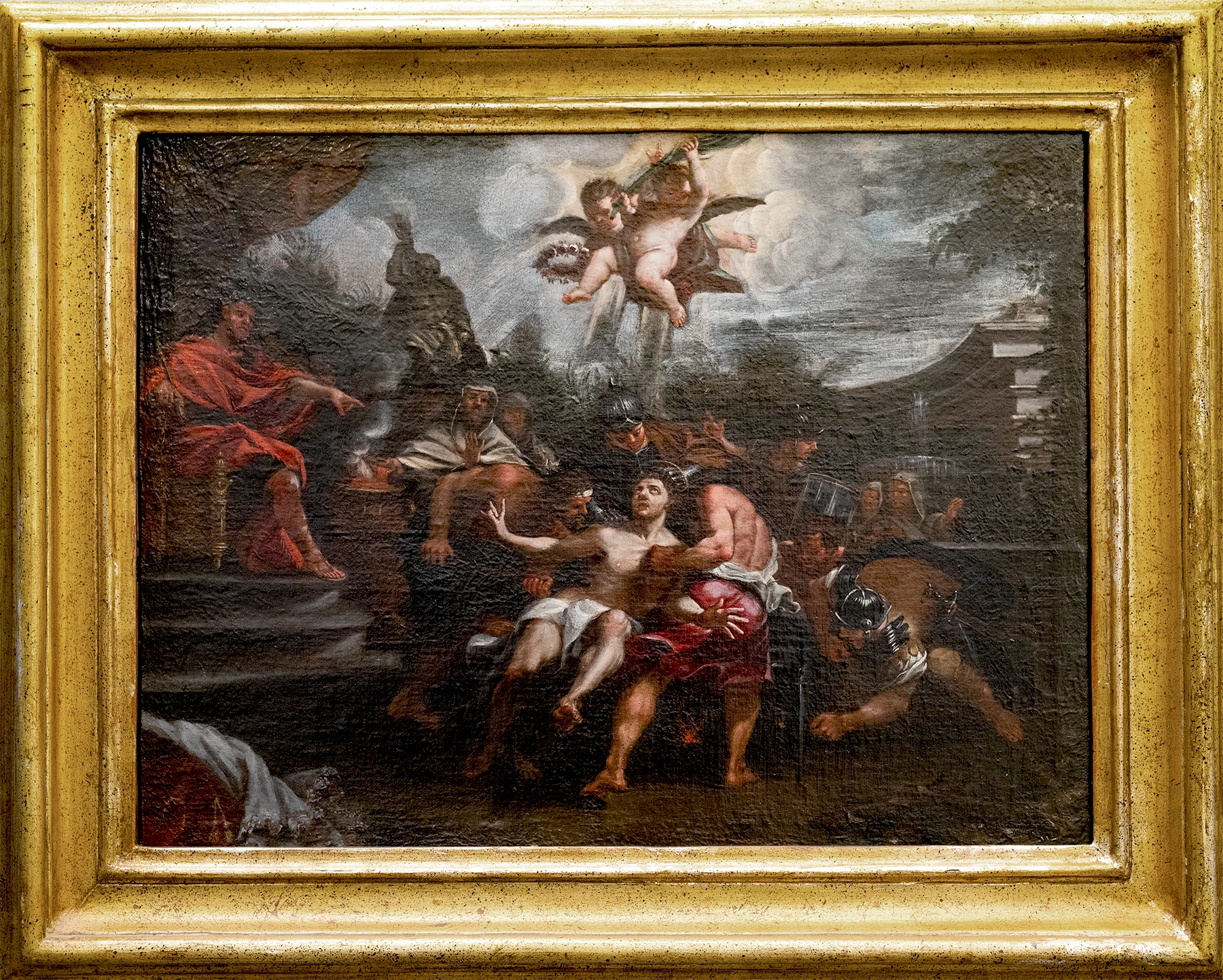
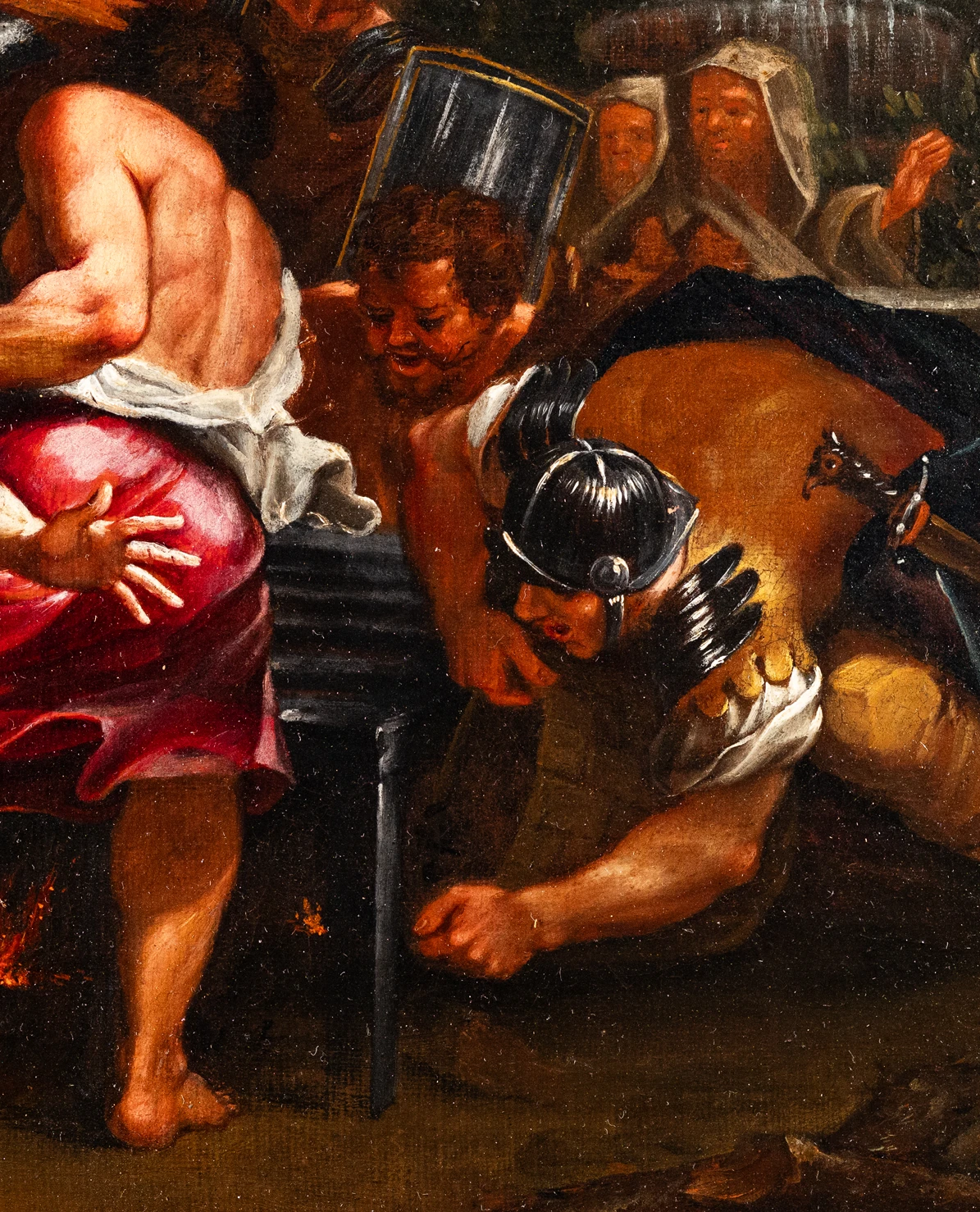
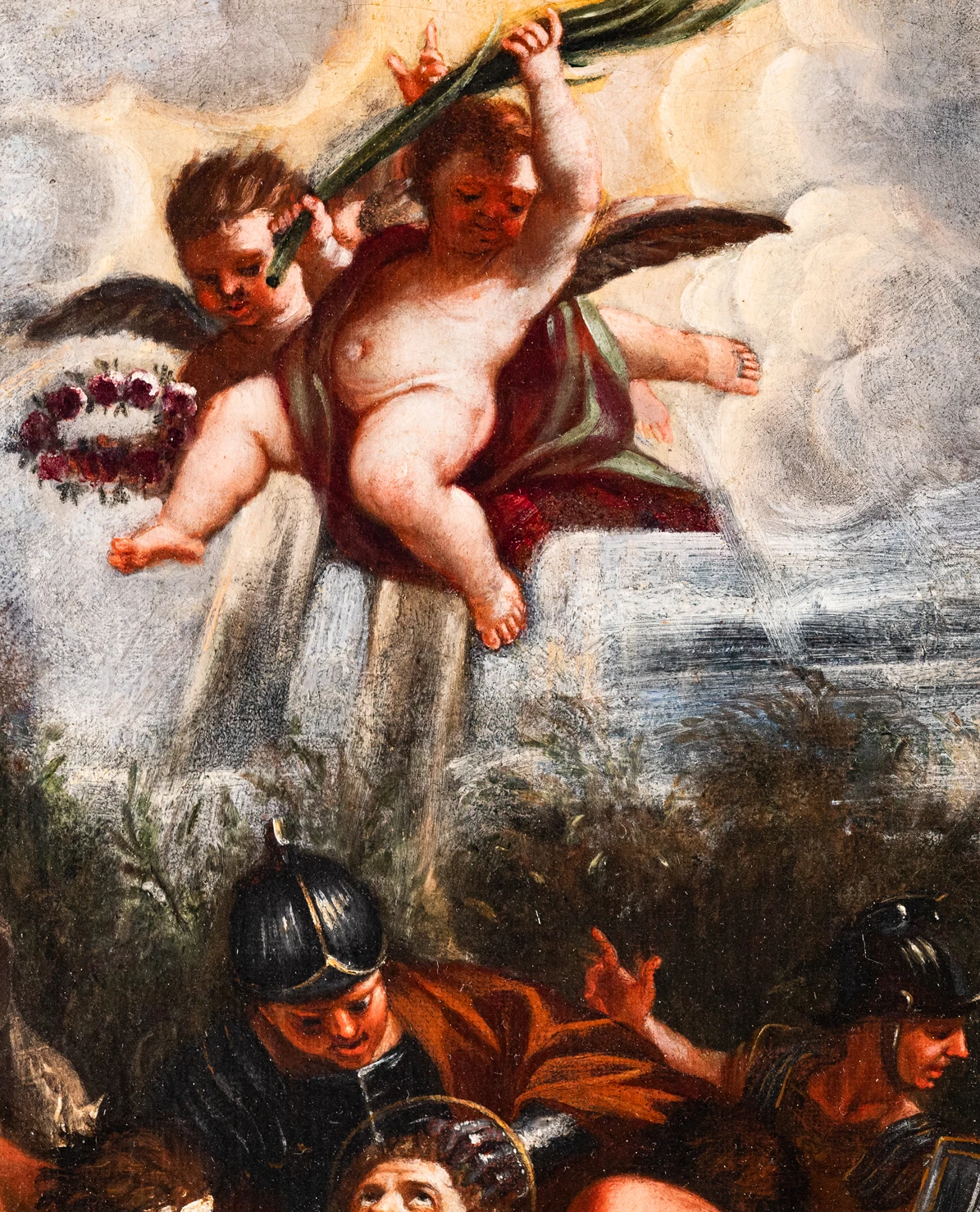
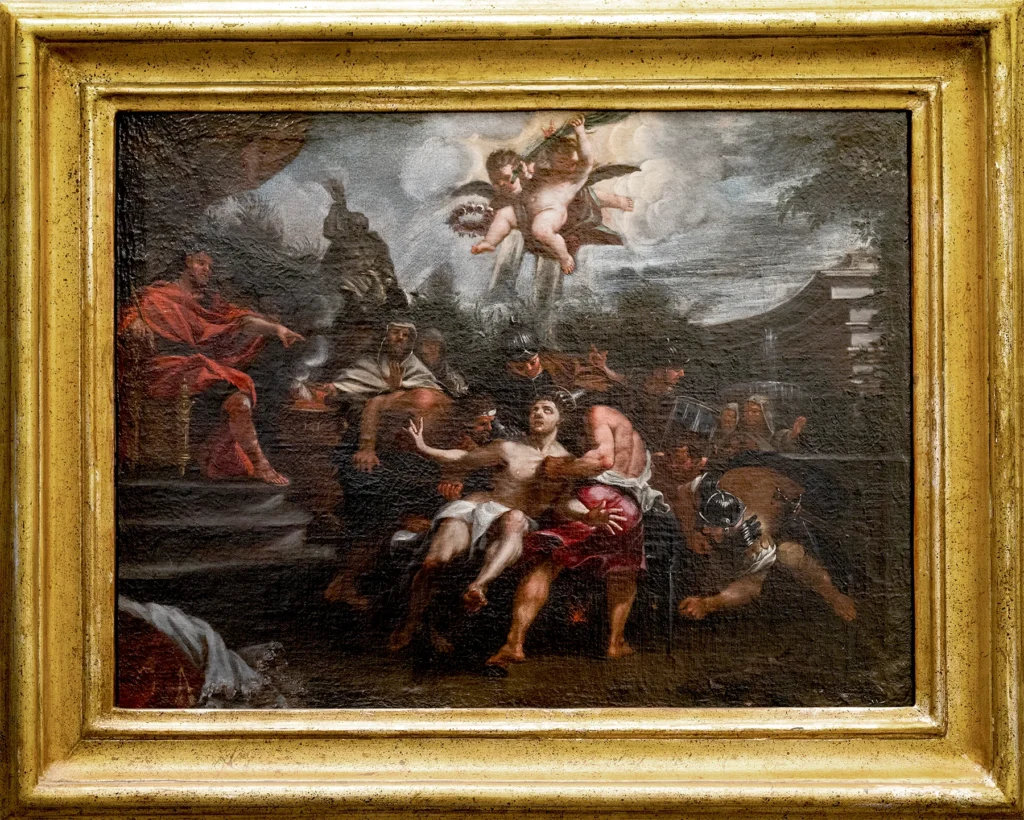
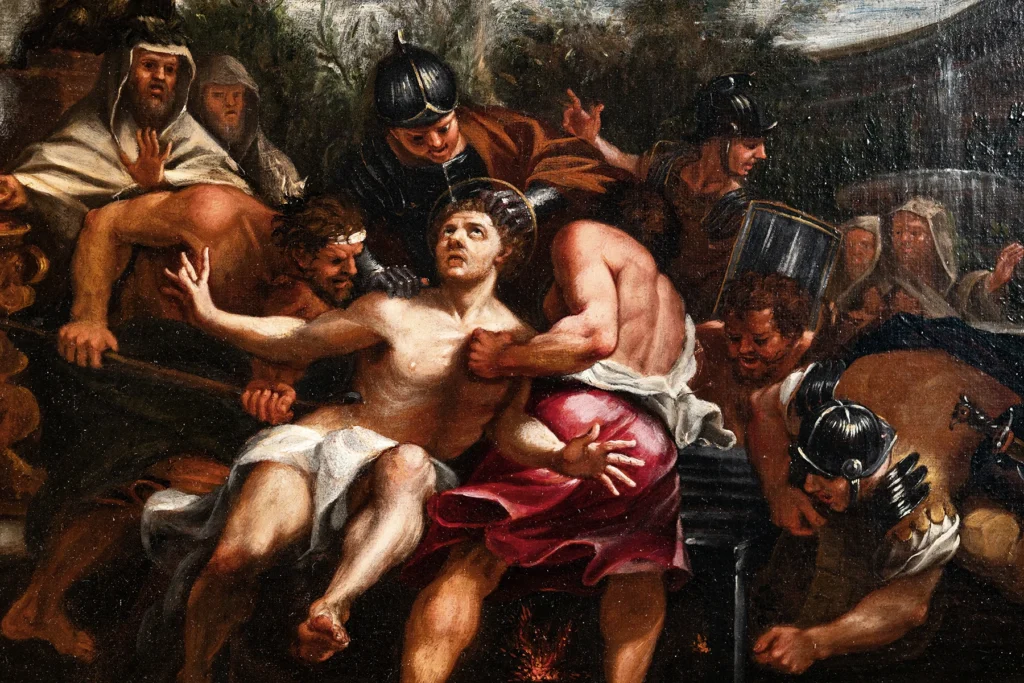
The painting under examination displays several characteristics typical of Baldi’s production. In the scene depicting the Martyrdom of Saint Lawrence, we find, much as in the fresco of the Martyrdom of Saint John in Oleo (1658, Oratory of San Giovanni a Porta Latina; Fig. 1), two flying angels bearing the martyr’s crown and palm, motifs frequently found in the painter’s works, as well as the figure of a crouching soldier tending the fire.
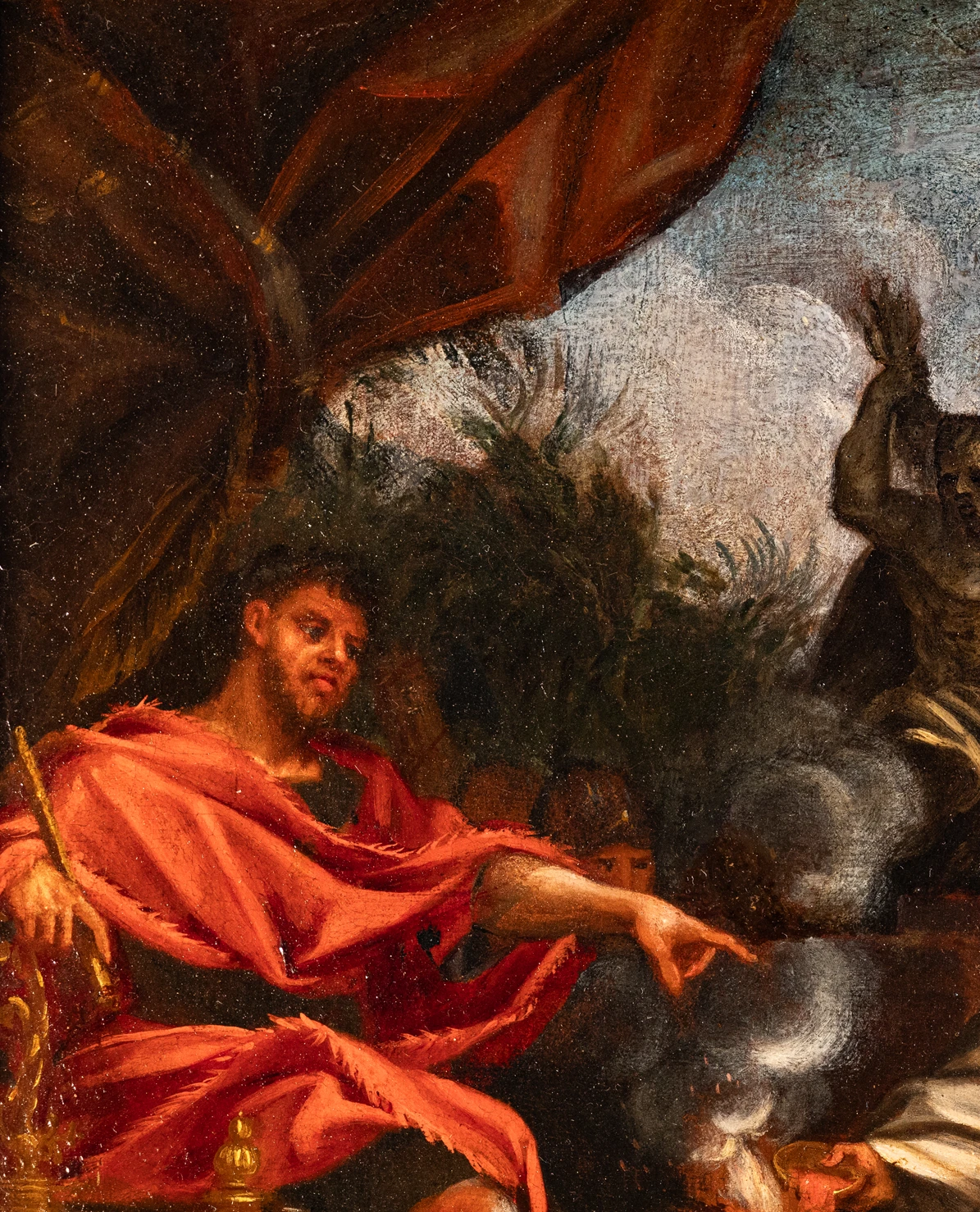
A comparable composition can also be observed in the Martyrdom of Saint John the Evangelist (Private Collection; formerly Venice, Semenzato, 14 July 1988), as well as in the Martyrdom of Saint Agatha (Fabriano, Church of San Venanzio), where the statue of Jupiter Tonans likewise appears.
It should also be noted that Baldi’s inventions had a significant impact on the creation and dissemination of sacred imagery throughout Europe. Prints, in particular, such as those engraved by Benoît Thiboust after Baldi’s drawings, played an important role in the spread of saints’ iconographies that would subsequently become canonical models for many later artists.
Selected Bibliography
- A. Pampalone, Disegni di Lazzaro Baldi nelle collezioni del Gabinetto Nazionale delle Stampe, 1979, pp. 147–156.
- V. Casale, “I quadri di canonizzazione,” Paragone, 33 (1982), no. 389, pp. 33–61.
- V. Casale, “Alcune precisazioni sui disegni di Lazzaro Baldi,” Prospettiva, no. 32, 1983, pp. 262–275.
- S. Ferraris, “Una confraternita ed una bottega artistica nella Roma intorno al 1700: la Compagnia della Madonna del Pianto e lo ‘studio’ di Lazzaro Baldi,” Storia dell’Arte, no. 58, 1986, pp. 247–274.
- M. Fagiolo dell’Arco, Pietro da Cortona e i ‘cortoneschi’. Bilancio di un centenario e qualche novità, Rome, Bulzoni Editore, 1998, pp. 177, 180 (note 19), fig. 56.
- M. Fagiolo dell’Arco, Pietro da Cortona e i ‘cortoneschi’. Gimignani, Romanelli, Baldi, il Borgognone, Ferri, Milan, Skira, 1998, p. 131, pl. LXIII.
- G. B. Fidanza, “Le vicende artistiche della chiesa di Sant’Anastasia al Palatino nel Seicento,” Bollettino d’Arte, no. 6 (April–June), 2010, pp. 123–144.
- V. Panfili, L’oratorio di San Francesco Saverio e della Madonna della Pietà detto del Caravita: Arti e devozioni, Master’s Thesis, 2019.
- M. Onori, “Natione Spagnuola”. Arte e committenza iberica a Roma (1647–1700), Master’s Thesis, Academic Year 2020/2021, p. 211.
- V. Casale, L’arte per le canonizzazioni: l’attività artistica intorno alle canonizzazioni e alle beatificazioni nel Seicento, 2011.
- A. Agresti, “Le canonizzazioni come impulso alla produzione artistica nella Spagna del XVII secolo,” in I rapporti tra Roma e Madrid nei secoli XVI e XVII: arte, diplomazia e politica, pp. 557–585.