The Artist: Marcel Pille
Marcel Pille (1867-19..) belongs to the refined school of French illustrators and watercolorists who worked during the Belle Époque, a period in which the quality of illustrated publishing reached extraordinary heights.
Born in Paris on February 4, 1867, he developed a body of work strongly oriented toward historical reconstruction, distinguishing himself for the elegance of his drawing, the precision of his settings, and his ability to convey complex episodes with visual immediacy.
His activity is documented through the leading French bibliographic institutions, including the Bibliothèque nationale de France, and through the numerous illustrated publications to which he contributed. His name is linked to important French publishers, including Édouard Pelletan and Alfred Mame & Fils, houses that selected artists of high technical quality. Notably, it was Pelletan who offered Marcel Pille and Henri Bellery-Desfontaines their first experiences in book illustration, with works including La Mandragore and L’Almanach du Bibliophile (1898).
This early collaboration soon led to more ambitious commissions: in 1899 Pille illustrated La Mandragore by Jean Lorrain for Pelletan, and the following year he produced sixteen compositions for Théocritus’s Les Syracusaines, ou les fêtes d’Adonis, translated by André Bellessort, engraved by Froment fils, in an edition of 350 copies. This bibliophile-quality work testifies to the high professional standing Pille achieved on the French art scene between the late 19th century and the early decades of the 20th.
It is also worth noting that Pille frequently returned to medieval and chivalric subject matter throughout his illustrative career — a recurring example being his illustrations for La Filleule de Du Guesclin — confirming the consistent thematic focus on historical reconstruction that is also evident in the present watercolor.
Although best known as an illustrator, his original works display fully pictorial qualities. His watercolors retain their own artistic autonomy and should not be regarded merely as supports for printing, but as complete works, characterized by compositional balance, mastery of color, and remarkable narrative sensitivity.
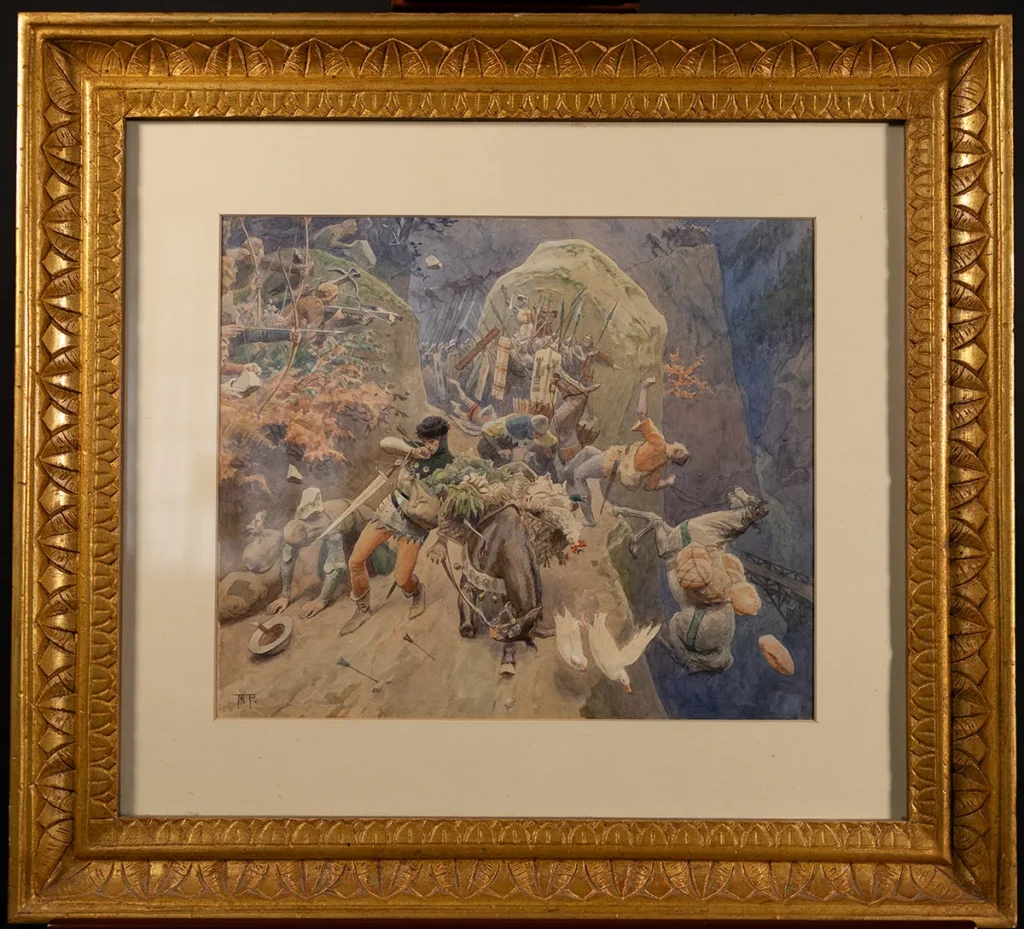
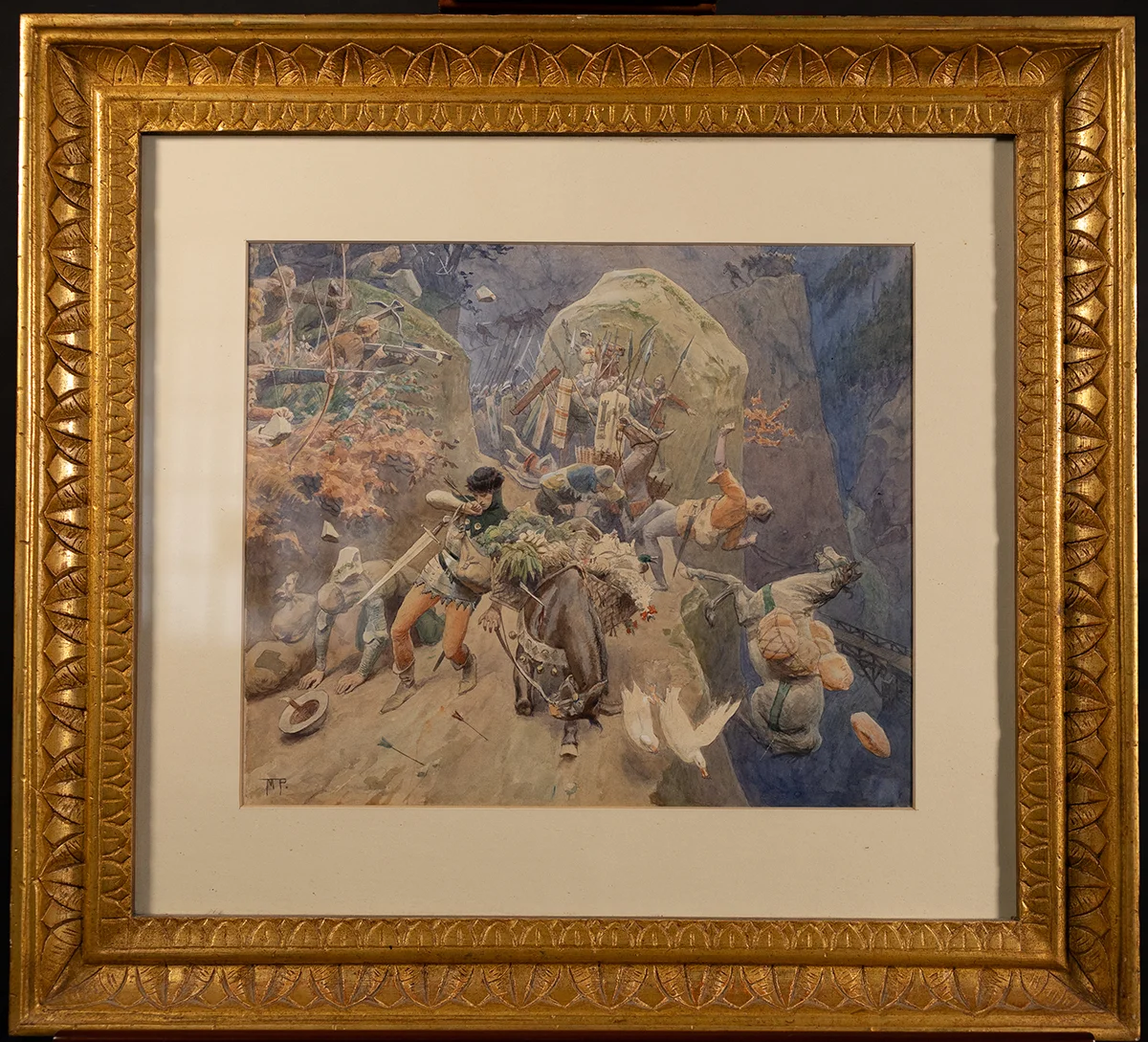
The work is presented in a carved and gilded wood frame, fully in keeping with French decorative taste of the late 19th century. The frame enhances the watercolor without overwhelming it, contributing to a harmonious and elegant whole that is immediately appealing when displayed.
Description of the Watercolor
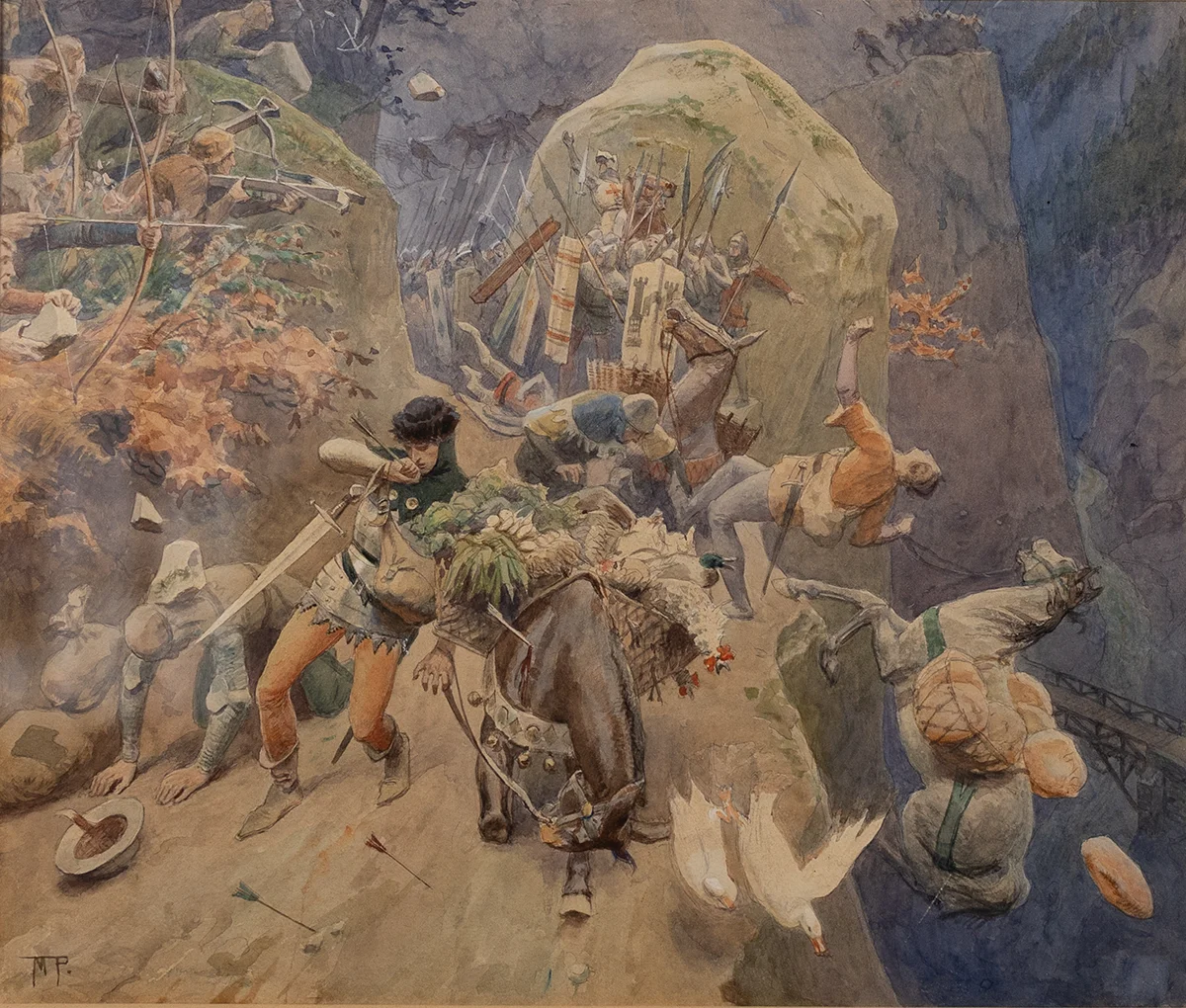
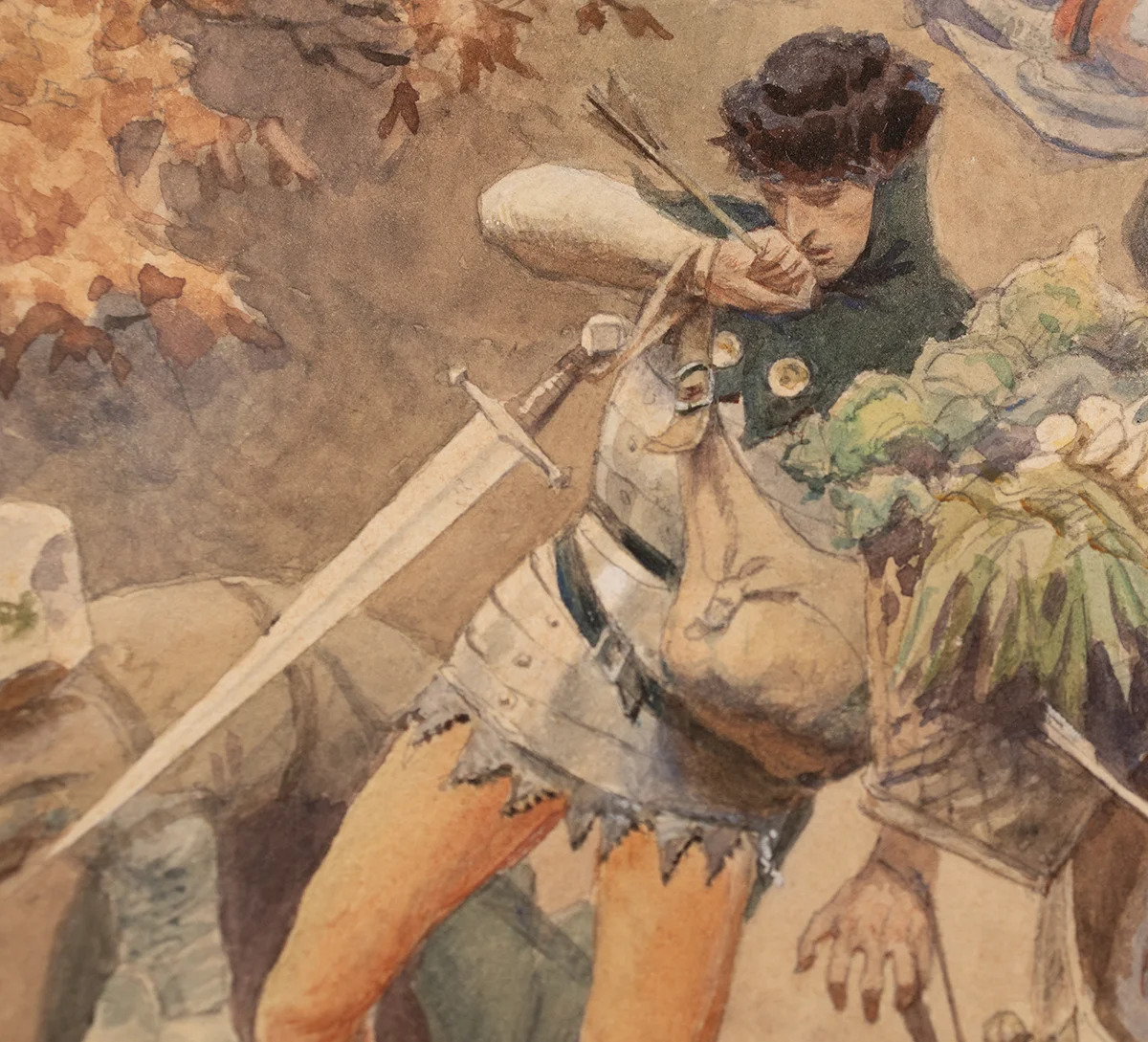
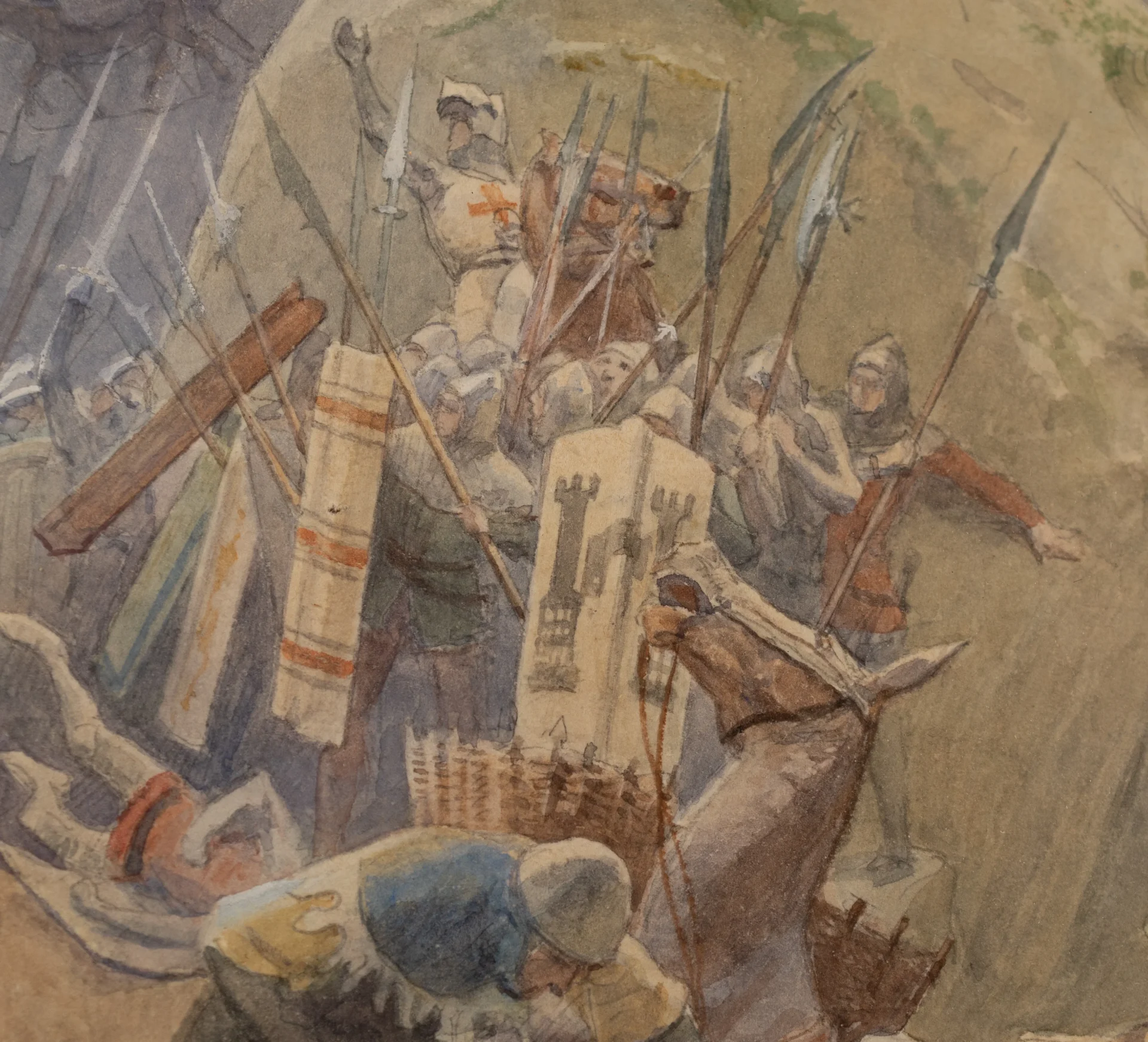
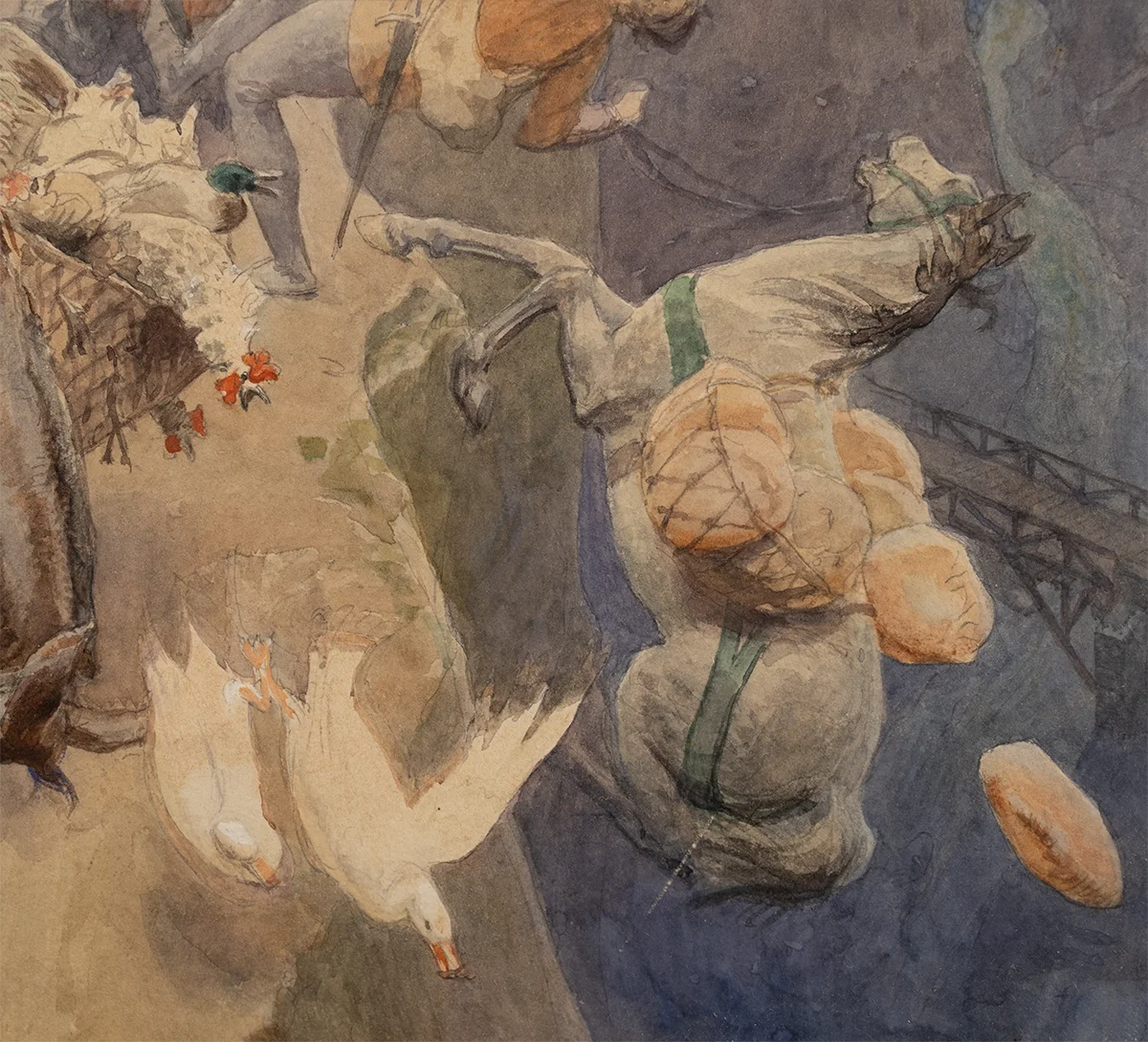
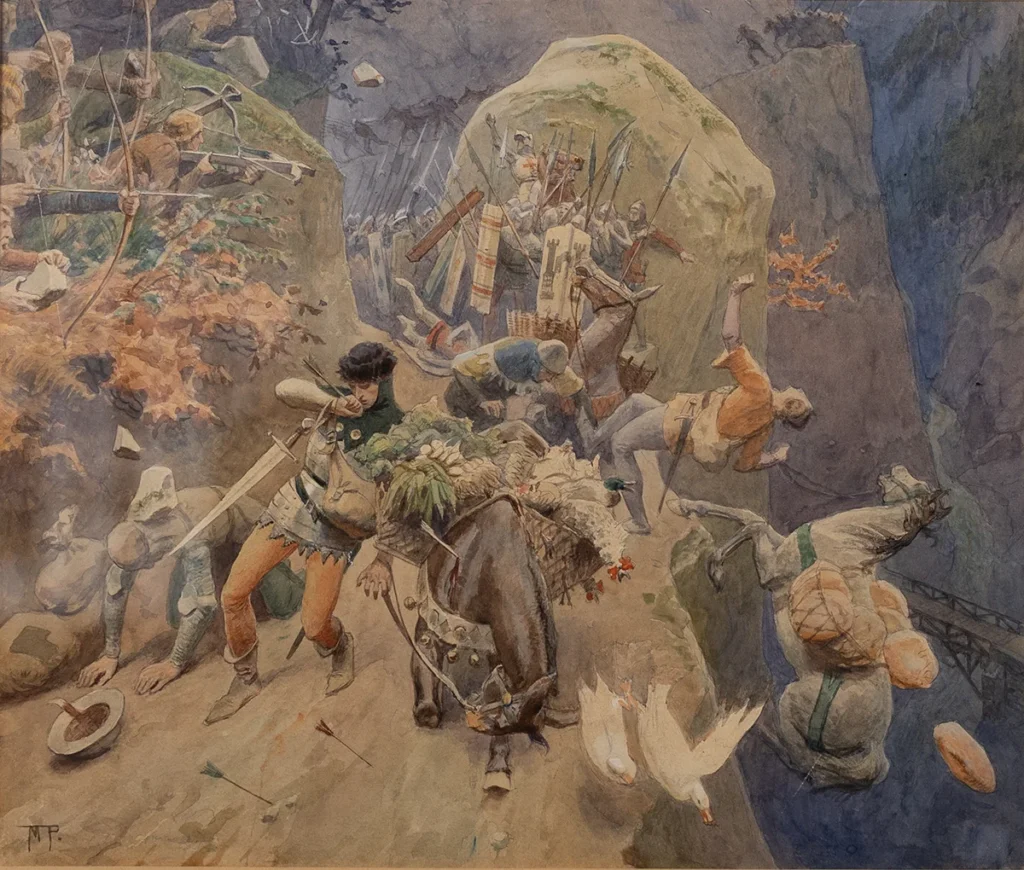
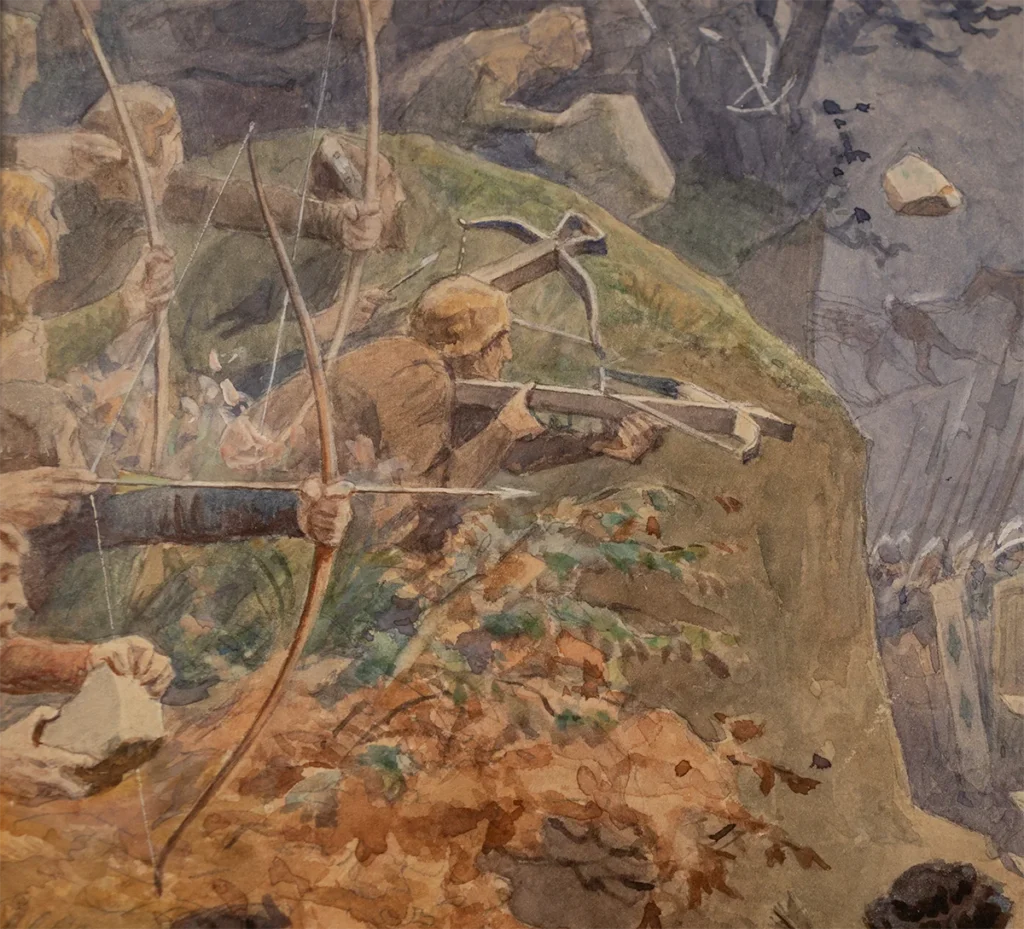
The work presents an engaging scene set in the medieval era. The action unfolds along a rugged mountain pass, where a convoy crosses a rocky gorge while becoming caught up in an armed clash. The composition is built with great balance: the foreground immediately introduces the heart of the scene, while the landscape gradually leads the eye toward the background, where other armed men and banners appear, broadening the narrative scope.
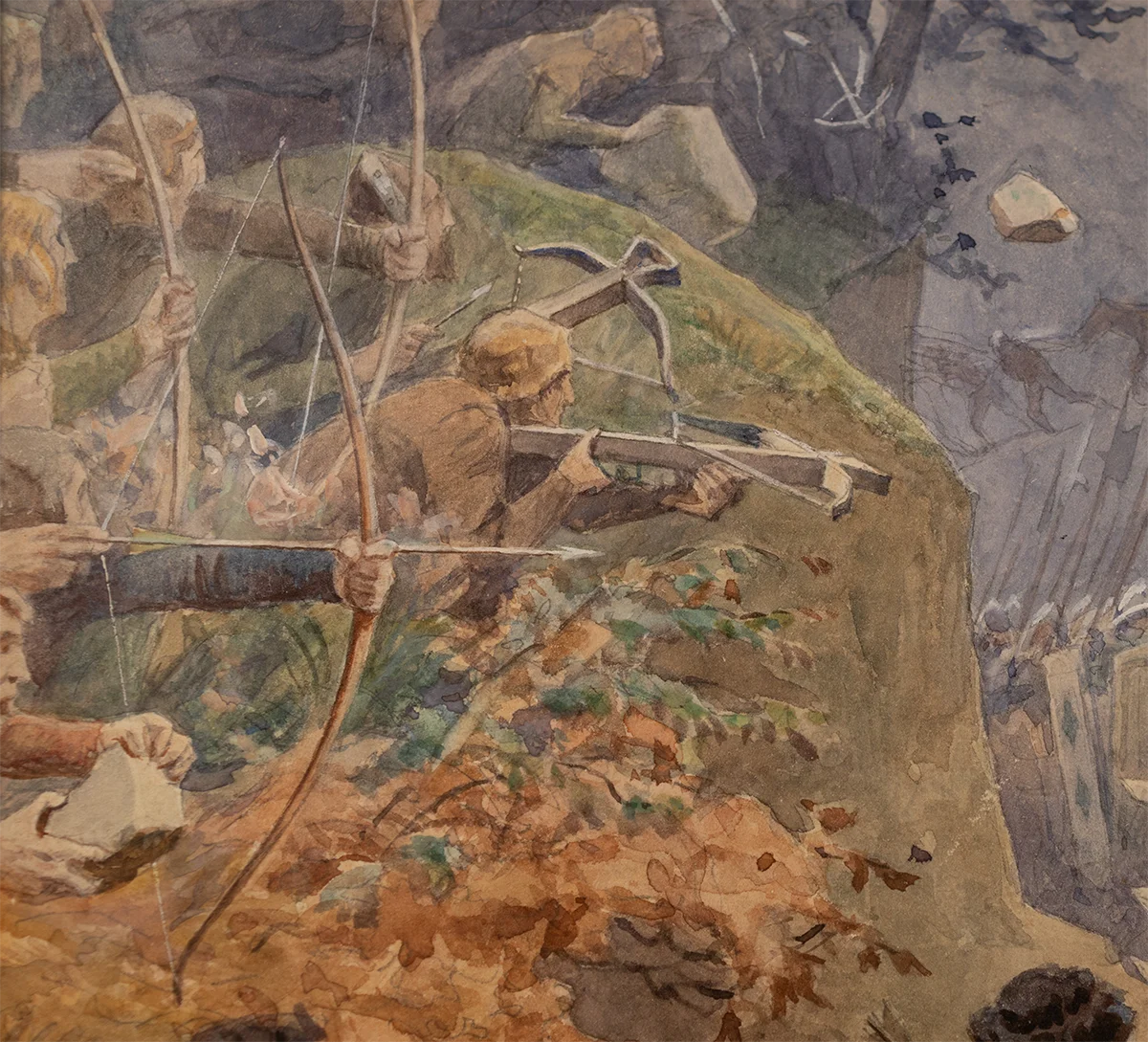
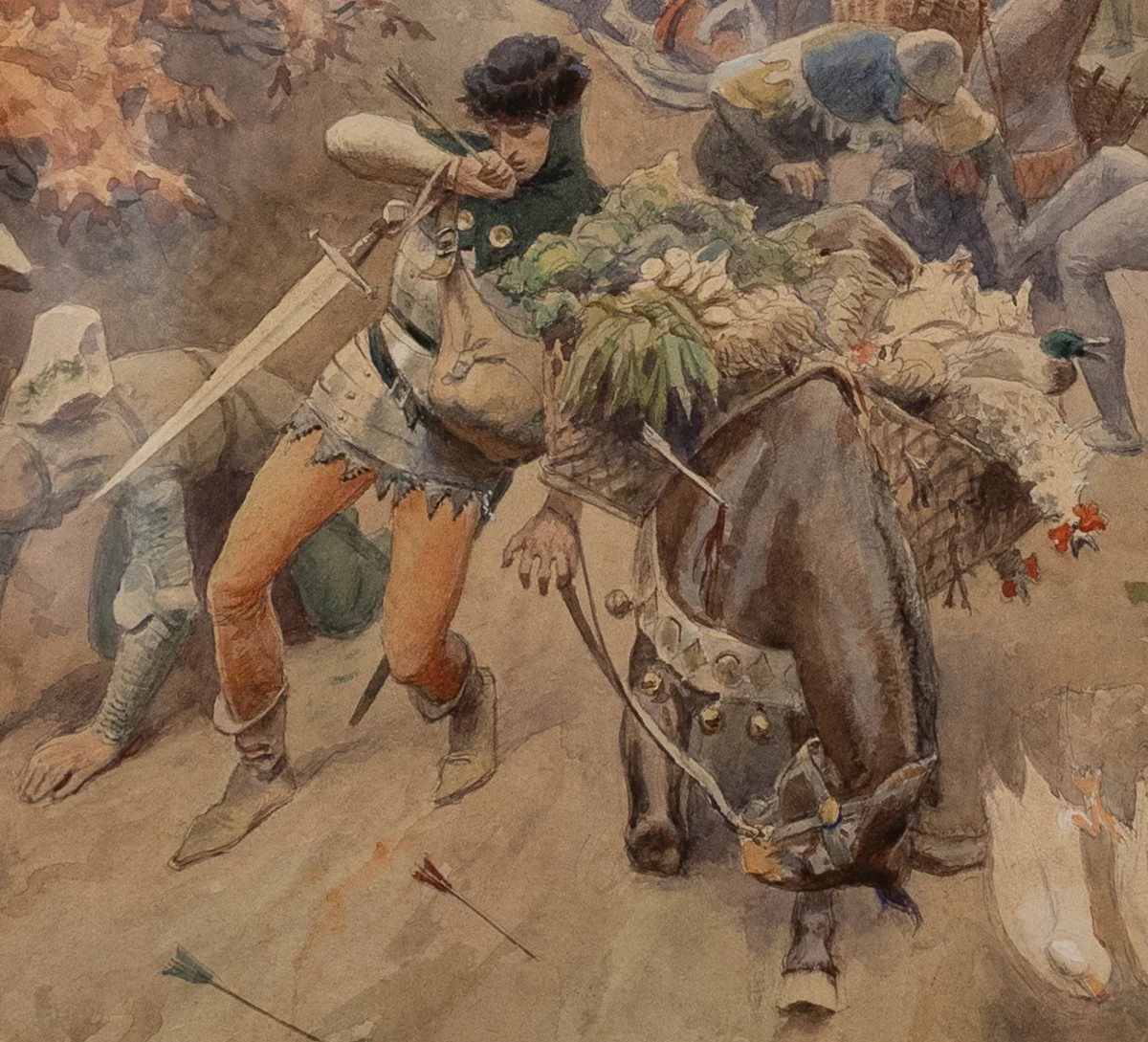
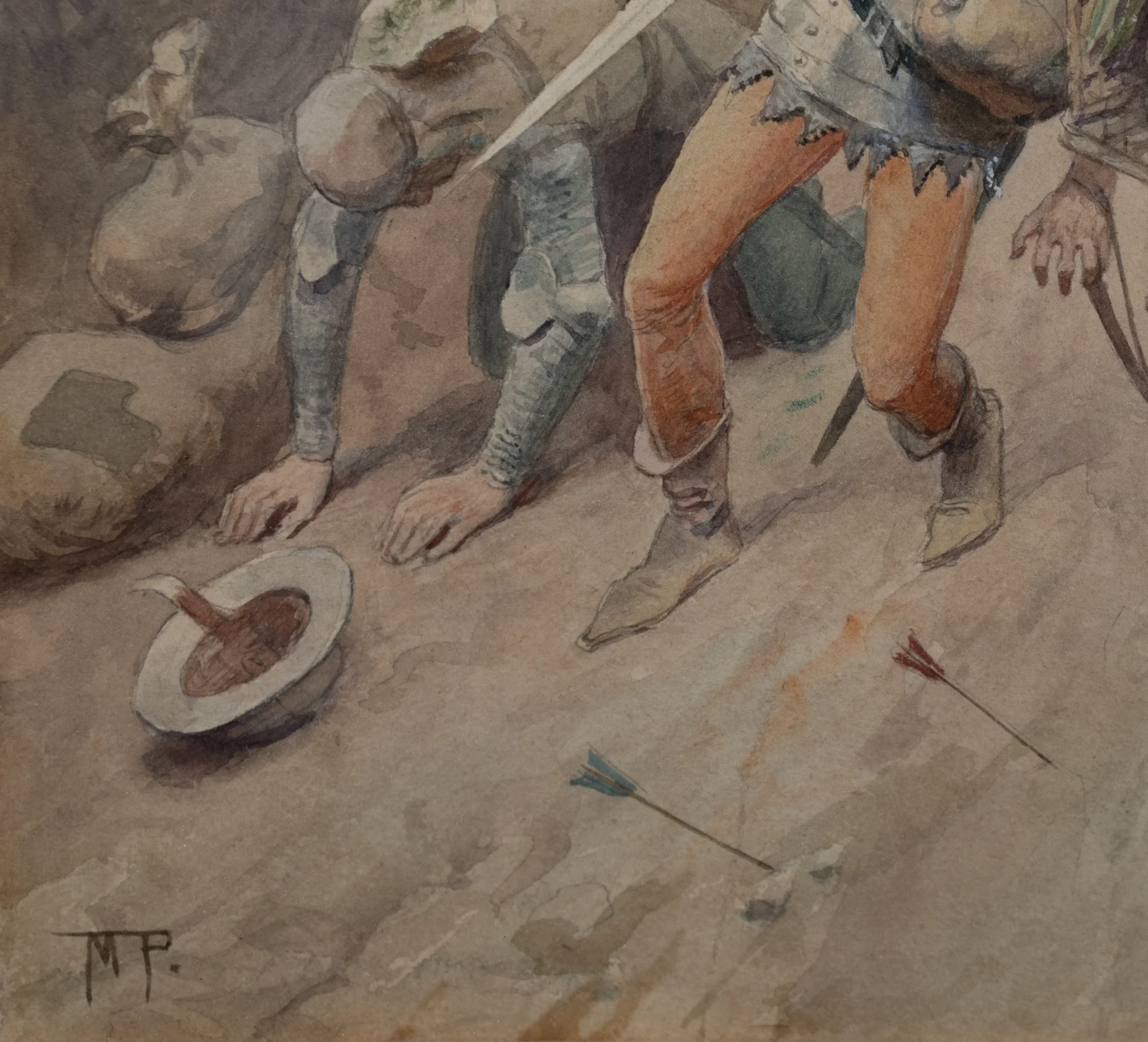
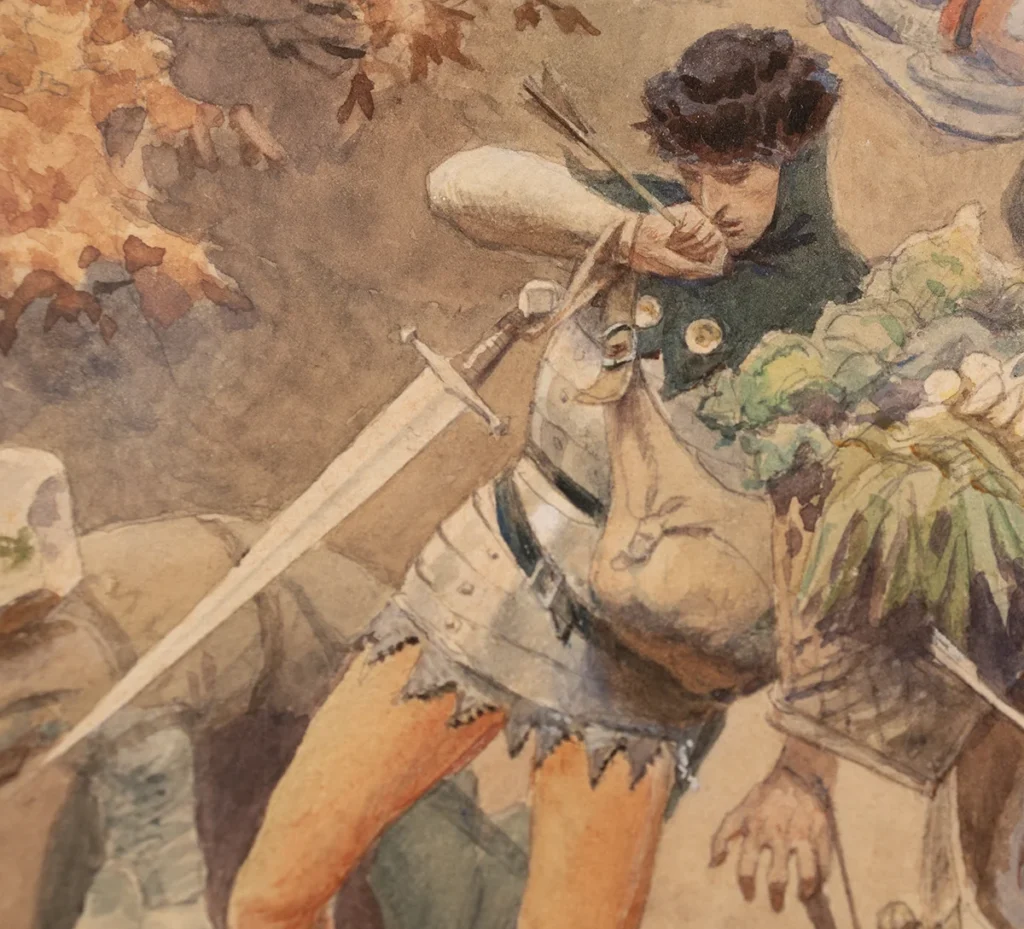
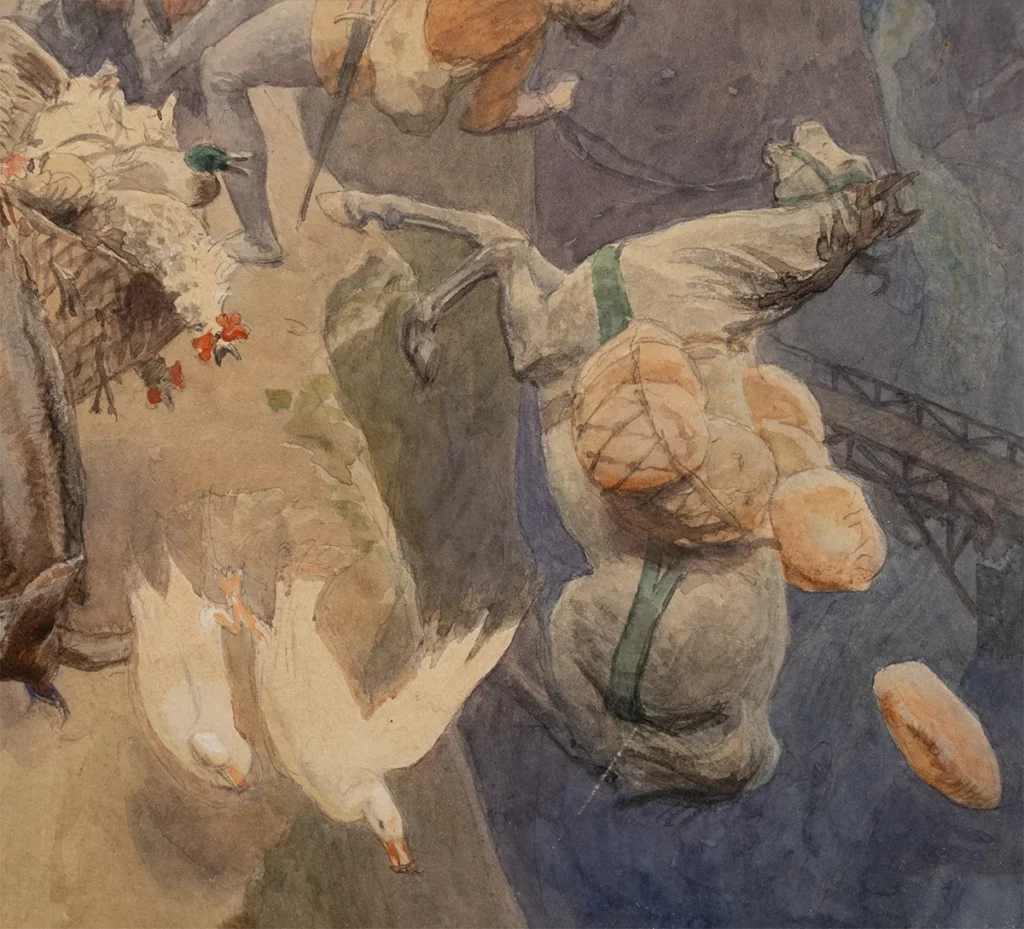
The viewer is naturally drawn into the painting. Every figure contributes to the story: the archers, the richly caparisoned mule, the soldiers, the animals, the objects scattered on the ground, and the vegetation together create a scene that is lively, dynamic, and believable. The artist avoids any theatrical excess, favoring a measured narrative in which tension arises from the arrangement of the figures rather than from the violence of the action.
Particularly successful is the ability to suggest movement. The diagonals created by the rocks, the weapons, and the postures of the figures lead the eye across the entire composition, lending it depth and visual continuity. This is a solution typical of the most skilled illustrators, capable of turning a historical episode into a thoroughly engaging narrative.
The composition reveals new details with every viewing: the rocky landscape, the figures in motion, the arrangement of the weapons, the pack animals, and the details of the equipment all combine to create a coherent and believable visual narrative. The artist’s attention to every decorative and narrative element is one of the work’s greatest strengths, demonstrating remarkable technical mastery and a compositional sensibility typical of the finest French school of the period.
Stylistic Analysis
The watercolor reveals a mature and confident technique. The drawing is precise but never rigid; the brushwork retains freshness and transparency, qualities that are among the most prized aspects of French watercolor painting of this period.
The palette is dominated by warm tones of ochre, earth colors, greens, and browns, harmonized by limited but effective chromatic accents that guide the reading of the image without disturbing its balance. The light models the landscape naturally and helps to separate the different perspective planes.
Particular attention should be paid to the care given to detail. Armor, weapons, harnesses, costumes, and animals are rendered with extreme precision, revealing a thorough knowledge of medieval iconography — a competence that aligns closely with the meticulous historical research Pille was known to apply to his book commissions. It is precisely these details that lend authenticity to the work and make it consistently engaging even after repeated viewings.
Collecting Interest
In recent years the market has shown growing interest in the French illustrators of the Belle Époque, especially when their original works retain full artistic autonomy. Watercolors by Marcel Pille are decidedly rarer than the illustrated publications that spread his name — such as the Pelletan editions of La Mandragore (1899) and Les Syracusaines (1900), which today survive mainly as bibliophile prints rather than original artworks — a circumstance that adds to the appeal of the present watercolor among antique collectors.
The work brings together numerous elements prized by collectors: a documented artist recognized by the Bibliothèque nationale de France, a historical subject of strong decorative impact, excellent execution, and a presentation enhanced by its antique frame. Its compact size also makes it easy to place, whether within specialized collections or in interiors furnished in a classic style.
More than a simple testament to French illustration, this watercolor represents a refined example of European figurative culture between the 19th and 20th centuries, combining historical precision, compositional elegance, and pictorial quality.
Conclusions
This watercolor stands as an interesting testament to the work of Marcel Pille and, more broadly, to the great era of French historical illustration — an era in which Pille established his reputation working alongside major publishers such as Édouard Pelletan. The quality of the drawing, the balance of the composition, the narrative richness, and the chromatic sensitivity make the work particularly appealing, both artistically and from a collecting standpoint.
The combination of refined pictorial execution, a subject of great charm, and an elegant presentation gives the piece considerable decorative value, making it suitable both for a specialized collection and for a formal setting.
Sources Cited
- Bibliothèque nationale de France, author record for Marcel Pille (1867-19..): https://data.bnf.fr/fr/ark:/12148/cb122166154
- Wikipédia (FR), “Marcel Pille: https://fr.wikipedia.org/wiki/Marcel_Pille
- Wikipédia (FR), “Édouard Pelletan” (reference to L’Almanach du Bibliophile 1898 and La Mandragore): https://fr.wikipedia.org/wiki/%C3%89douard_Pelletan
- “Bibliographie d’Édouard Pelletan: 1900, 1901, 1902” (details on Les Syracusaines, 1900): https://publicationscalamar.wordpress.com/2025/10/05/bibliographie-dedouard-pelletan-1900-1901-1902/
- Librairie Blaizot, bibliographic record for La Mandragore, Jean Lorrain, ill. Marcel Pille, Pelletan 1899: https://www.blaizot.com/livres-illustres/3601-france-anatole.html
- Goodreads, “Marcel Pille (Illustrator of La Mandragore)”: https://www.goodreads.com/author/show/13547879.Marcel_Pille
- Pinterest, reference to La filleule de Du Guesclin, illustrations by Marcel Pille: https://www.pinterest.com/pin/509117932858761040/