Description
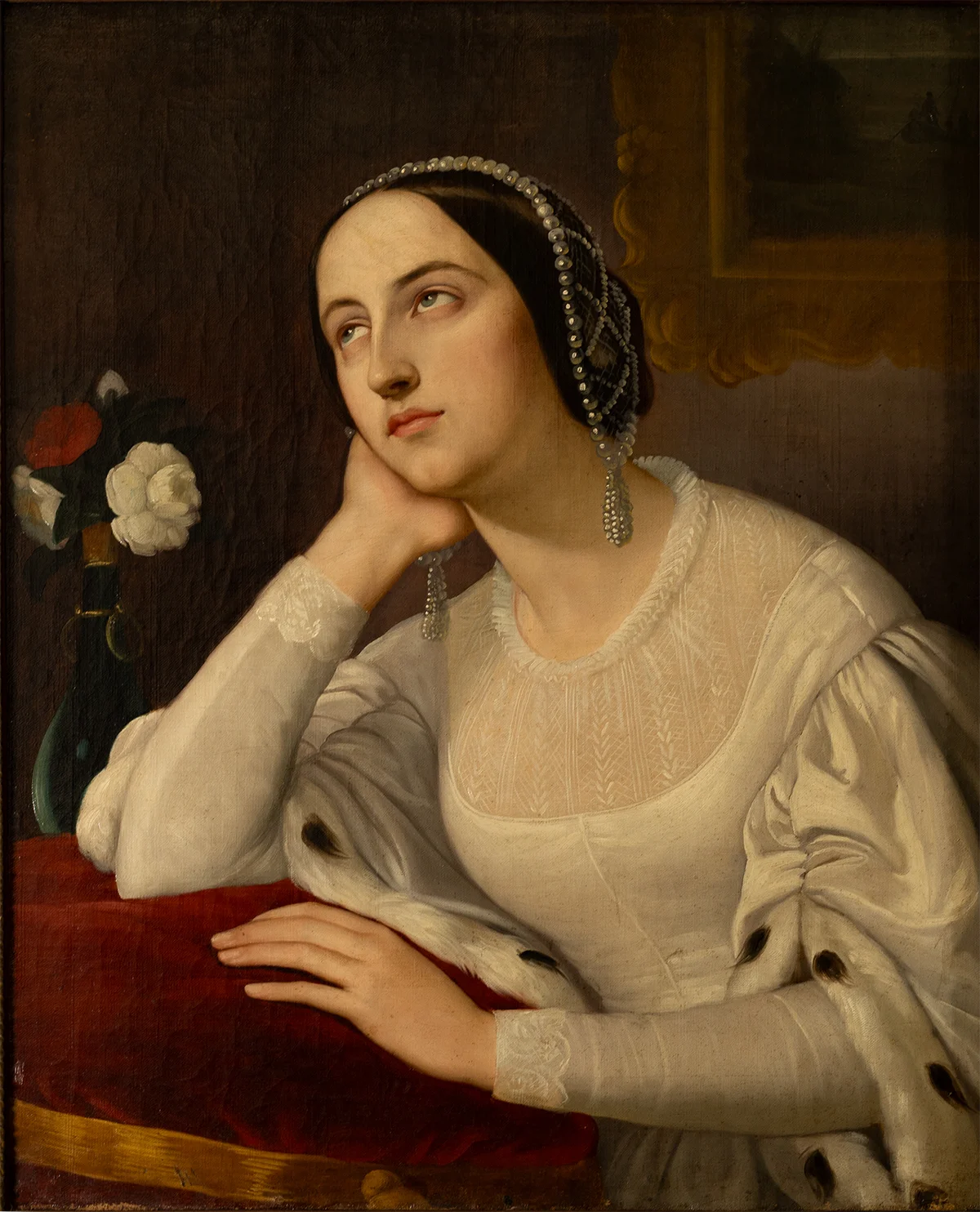
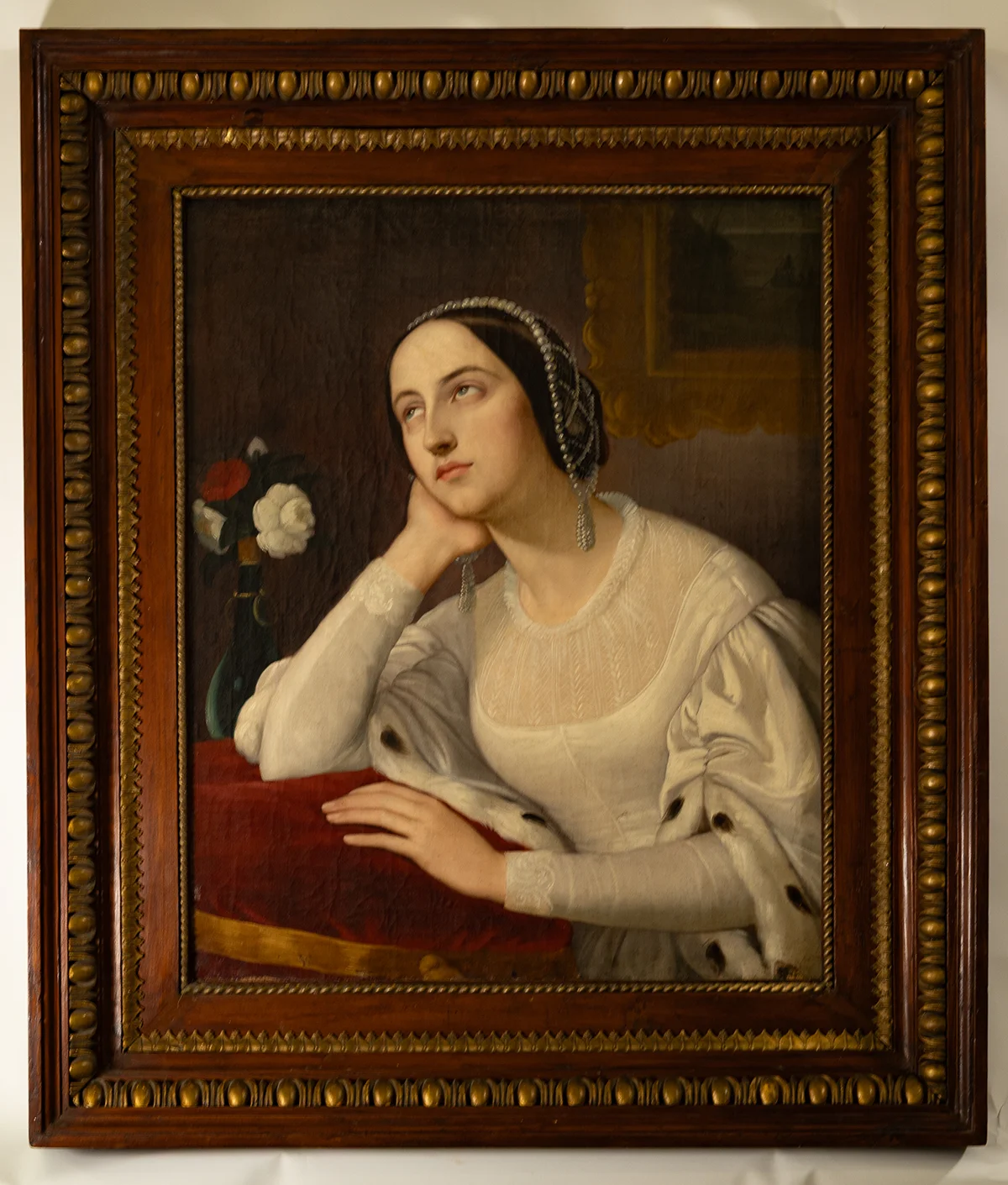
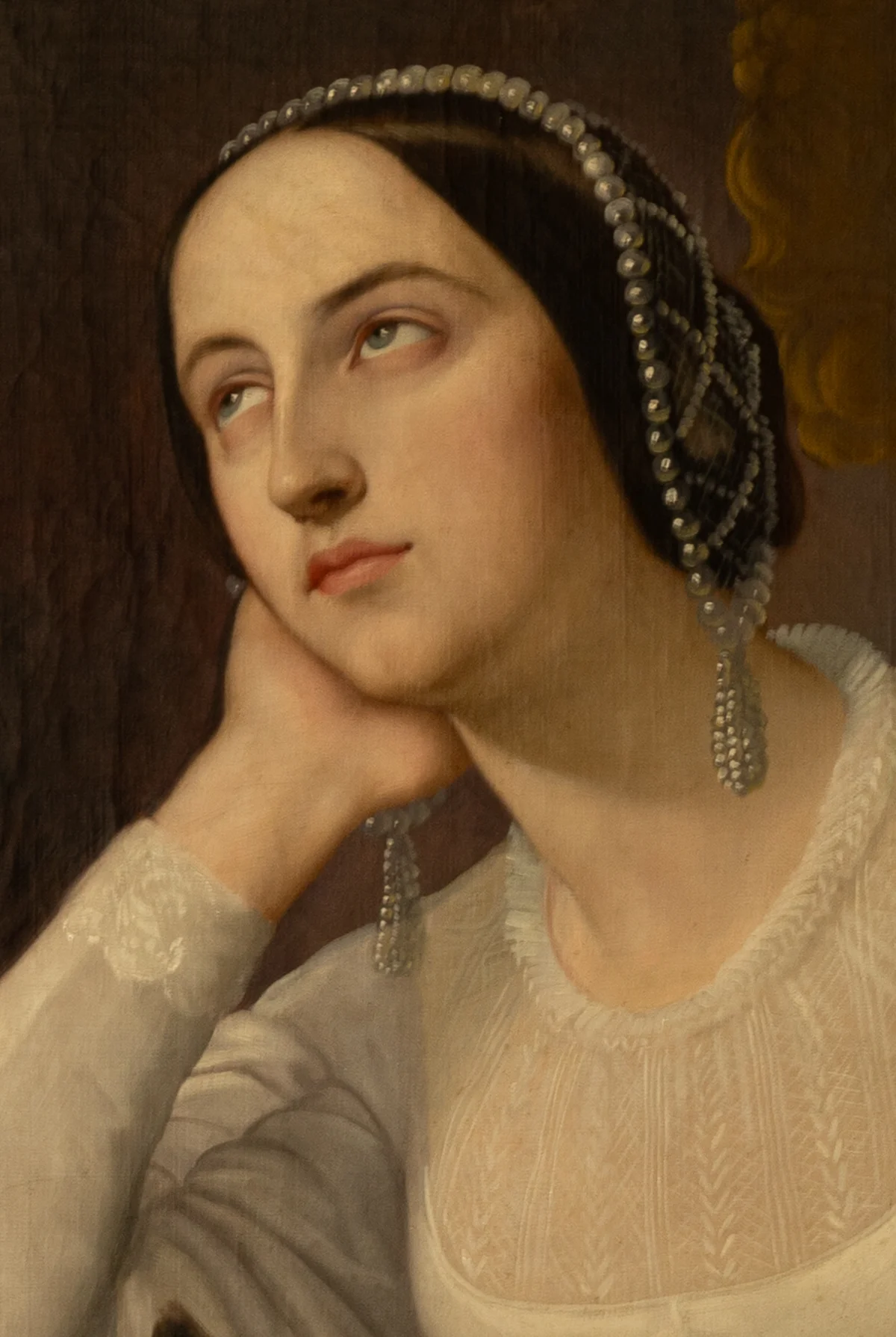
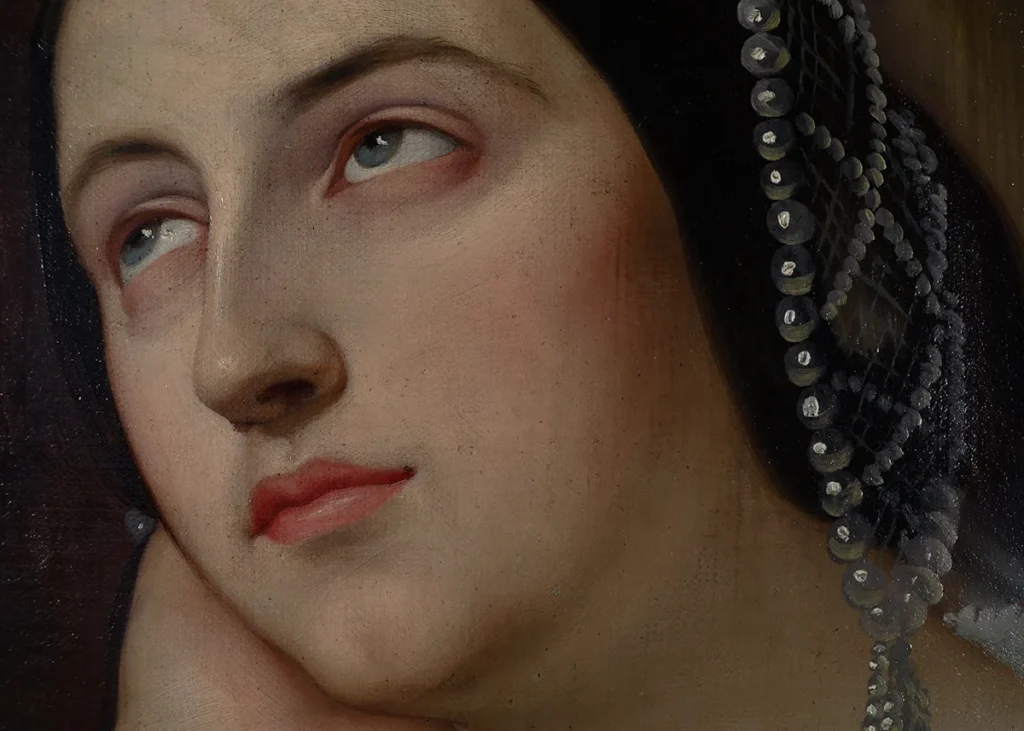
The painting depicts the celebrated actress Adelaide Ristori (1822–1906) in the role of Francesca da Rimini, protagonist of the eponymous tragedy by Silvio Pellico, inspired by Canto V of Dante Alighieri’s Inferno. The figure is shown half-length, in a slight three-quarter pose, captured in a moment of intense reflection: her head, gently tilted, rests on her right hand, while her upward gaze suggests a mood of melancholic contemplation — one of the distinctive traits of Romantic sensibility.
The compositional structure fully reflects the taste of mid-nineteenth-century theatrical portraiture, in which the painter does not merely aim to depict the performer’s likeness but rather seeks to convey the psychological dimension of the character she embodies. Morani thus constructs an image suspended between portraiture and idealized representation, in which the sitter appears to fully identify with Dante’s tragic heroine.
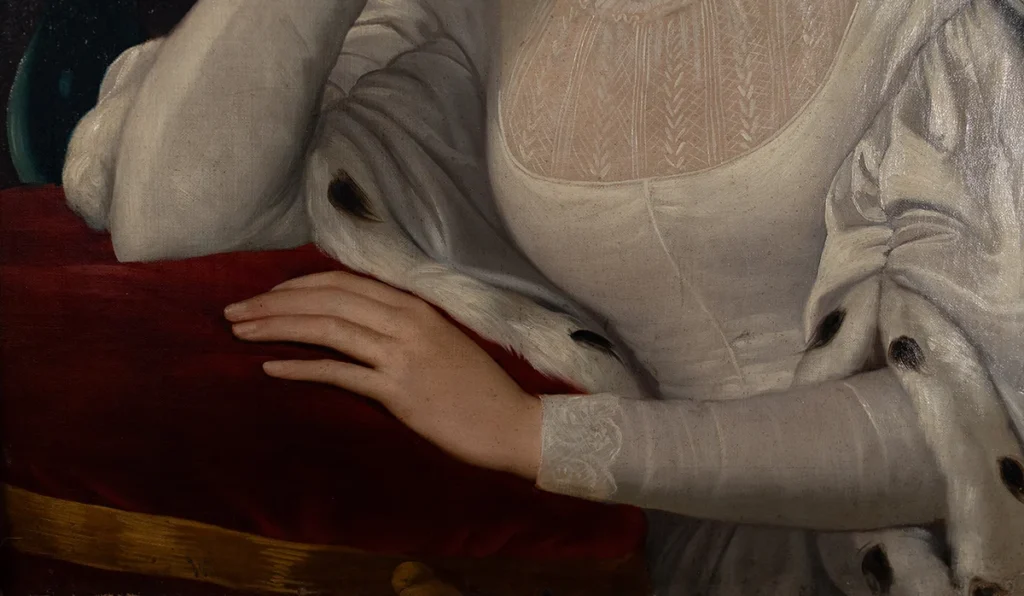
The white stage costume dominates the entire composition and stands as one of the work’s most refined elements. The fabric, rendered through subtle glazes, conveys the lightness of the material and the softness of its folds, while the embroidery at the neckline and the delicate lace cuffs attest to the artist’s great attention to detail. On her head appears a precious beaded hairnet, an accessory inspired by the medieval-style costumes used in Romantic theater and fully consistent with the fourteenth-century setting of the tragedy.
The chromatic balance is built on a few skillfully orchestrated colors: the luminous white of the gown dialogues with the deep red of the velvet covering the table and the warm browns of the background, while a small vase holding a red rose and a white camellia introduces a decorative note of great elegance. The soft, diffused light naturally models the face and hands, avoiding any theatrical effect and focusing attention on the sitter’s expression.
The execution reveals an extremely controlled style of painting, characterized by precise draftsmanship, smooth surfaces, and exceptionally delicate tonal transitions — qualities that place the work within the finest phase of Roman Purism, a movement of which Morani represents one of the most interesting exponents.
Stylistic Analysis
Stylistically, the work represents a significant example of mid-nineteenth-century Roman Purist painting.
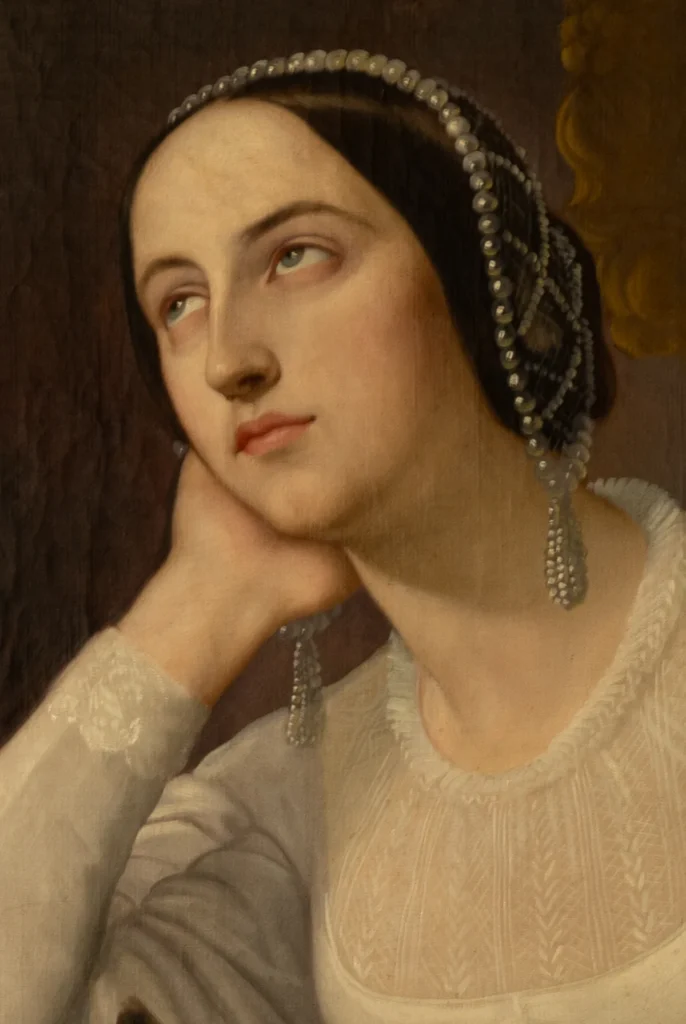
The compositional layout is deliberately simple, free of superfluous narrative elements. Morani concentrates attention on the figure and facial expression, avoiding any spectacular effect. The anatomical construction is solid, the drawing accurate, and the brushwork almost entirely invisible, following a technique that favors continuity of modeling over any evident materiality of paint.
Particularly successful is the rendering of the flesh tones, achieved through a succession of extremely fine glazes that lend naturalness and luminosity to the face. The quality of execution is equally evident in the depiction of the different materials: the velvet of the table, the fabric of the gown, the embroidery, the glass of the vase, and the beads of the hairnet are each rendered with distinct yet perfectly harmonized sensitivity.
The deliberately restrained color palette heightens the intimate character of the scene and demonstrates notable compositional maturity.
The work remained in the Romitelli-Morani Collection, direct descendants of the artist, until its recent entry onto the art market. This provenance is of particular importance, as it allows for the reconstruction of a historical and collecting continuity rarely preserved for paintings of this period.
Vincenzo Morani
Born in Polistena in 1809, Vincenzo Morani trained at the Royal Academy of Naples under Costanzo Angelini and Camillo Guerra, later completing his artistic development in Rome, where he settled permanently in 1834.
In the capital he worked for major aristocratic and religious patrons, producing numerous decorative cycles and altarpieces for the Torlonia family, for Ferdinand II of the Bourbons, and for various religious orders. At the same time, he developed a portrait production of particular quality, today regarded as among the most refined aspects of his output.
His painting emerges from the encounter between rigorous Neapolitan academic training and the culture of Roman Purism. Precise draftsmanship, delicacy of modeling, and the pursuit of a composed, measured beauty are the distinctive elements of his pictorial language.
The present painting belongs to the most accomplished phase of his activity as a portraitist and testifies to the full artistic maturity he achieved
Adelaide Ristori and the Role of Francesca da Rimini
Adelaide Ristori is unanimously regarded as the greatest Italian tragic actress of the nineteenth century. Her career, which unfolded across the major theaters of Italy and Europe, played a decisive role in spreading Italian theater throughout the world and made her one of the most celebrated artistic figures of her time.
The role of Francesca da Rimini marked one of the defining moments of her career. First performed when she was still a teenager, it accompanied the actress for much of her artistic life and played a decisive part in shaping her public image. Francesca perfectly embodied the Romantic ideal of the tragic woman, torn between love, destiny, and fate — qualities Ristori was able to interpret with extraordinary intensity.
The painting documents precisely this phase of her career, when the young actress had already won over the Roman public and was beginning to establish herself as one of the leading figures of the Italian theatrical stage.
Historical and Collecting Interest
The work is of particular interest on several counts.
It is, first of all, a portrait fully identified both in subject and in the person represented — a circumstance not common in nineteenth-century portraiture. To its pictorial quality is added the historical value of depicting Adelaide Ristori, a central figure of Italian and European theatrical culture, portrayed in the very role that, more than any other, contributed to her international fame.
Within the context of Vincenzo Morani’s overall production, the painting also stands as one of the most interesting testimonies of his portraiture — a smaller but particularly esteemed portion of his body of work. Its direct provenance from the artist’s own family adds a further element of significance, as it guarantees documentary continuity and reinforces the attributional soundness of the painting.
The convergence of these elements — a documented author, a historically identifiable subject, a high level of execution, and family provenance — makes the work of particular interest both to collectors of nineteenth-century Italian painting and to those focused on the history of theater and Romanticism.

Frame
The painting is sold unframed. Two different display options are available upon request:
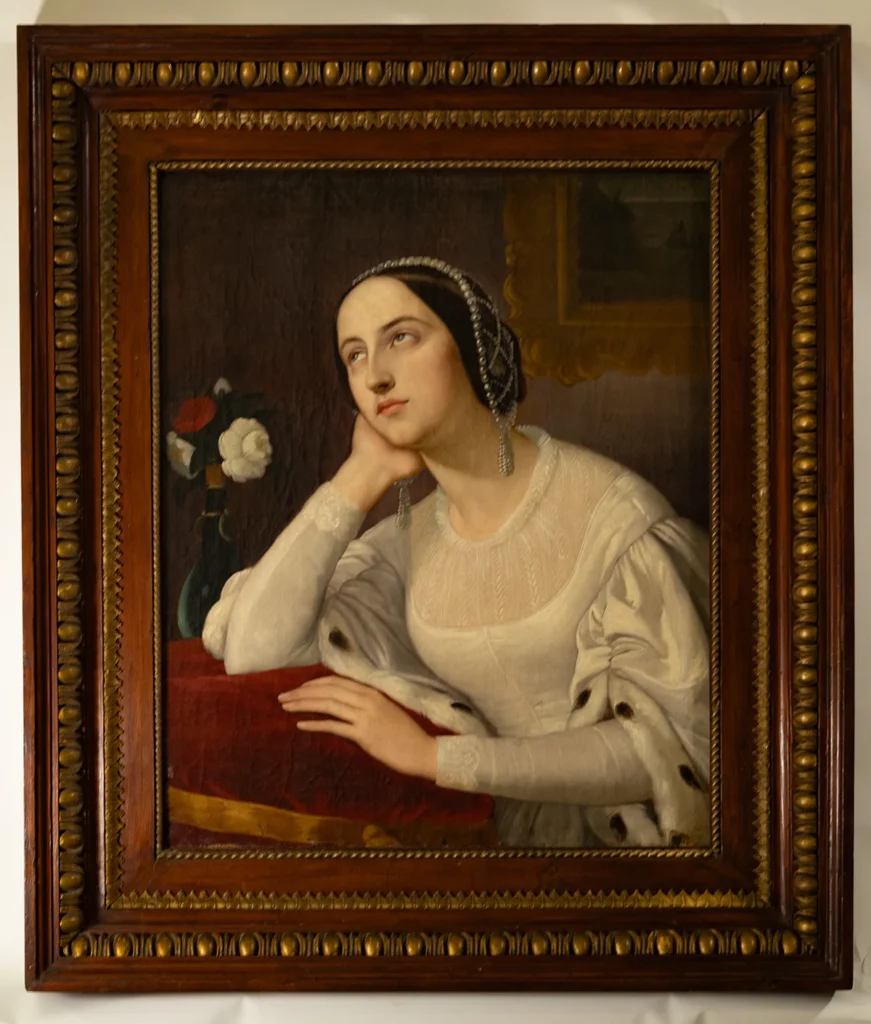
Option 1 – Antique frame The frame shown in the photographs is carved wood with mecca gilding. The decoration features an outer band with an egg-and-dart motif, a central cove veneered in walnut, and an inner band with a lanceolate leaf motif. In type and ornamental taste, it may be considered contemporary, or only slightly later, to the execution of the painting, and is fully in keeping with mid-nineteenth-century painting.
Option 2 – Modern frame in period style A modern frame made according to nineteenth-century models is also available, suited to enhancing the work while maintaining a classical presentation.
Select Bibliography
- Dizionario Biografico degli Italiani, entry: Vincenzo Morani
- F. Napier, Pittura napoletana dell’Ottocento
- G. Ceci, Thieme-Becker Künstlerlexikon
- S. Gnisci, La pittura in Italia. L’Ottocento
- A. Caruso, La famiglia Morani di Polistena
- Adelaide Ristori, Studies and Memoirs